

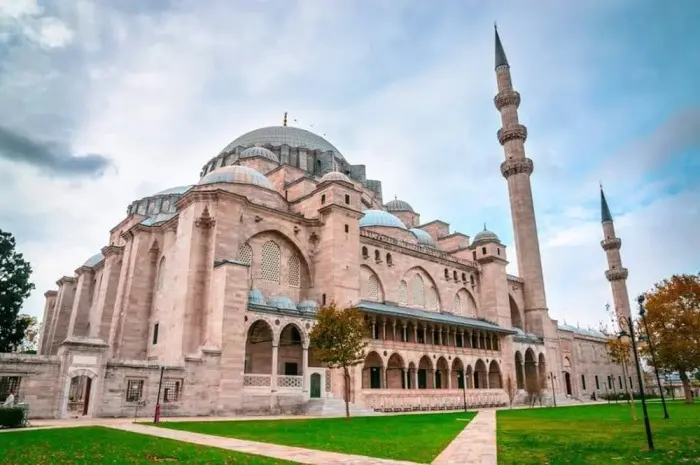
Hagia Sophia is a historic building that combines history, unique architecture, and deep religious influences, making it a must-see tourist destination.
Hagia Sophia, a historical building located in the heart of Istanbul, Turkey, has witnessed a long journey of world history. With its magnificent architecture, changing functionality, and its role in culture and religion, Hagia Sophia is a place full of stories and attractions.
From a megachurch for Christians to a mosque that is an icon of the Muslim world, here are 10 interesting facts about the Hagia Sophia that you might not know.
1. Hagia Sophia was designed by a famous architect of its time
Hagia Sophia was built in a very short time, only six years, and was completed in 537 AD. The main architects responsible for the construction of the Hagia Sophia were Anthemius of Tralles and Isidore of Miletus, two renowned architects who had expertise in mechanics and mathematics.
Their skill in designing intricate structures with large domes is one of the reasons why the Hagia Sophia is so architecturally impressive.
The beautiful mosaics that adorn the walls of Hagia Sophia are one of the main sources of knowledge of Byzantine mosaic art, illustrating a rich artistic tradition that followed the end of the Iconoclastic Controversy in the 8th and 9th centuries.
Exploring Hagia Sophia is one of the must-do activities on the list of Things to do Türkiye, offering visitors a glimpse into the country’s rich historical and cultural heritage.
2. Originally Built As A Church
The Hagia Sophia was first built in the 6th century AD, between 532 and 537 AD, by the Byzantine Emperor Justinian I. It was originally a cathedral church that became the spiritual and administrative center for Eastern Orthodox Christians.
The Hagia Sophia served as the principal church of Constantinople (now Istanbul) for nearly 1,000 years, and is one of the finest examples of magnificent Byzantine architecture.
3. Converted into a Mosque After the Conquest of Constantinople
In 1453, after the conquest of Constantinople by the Ottoman Empire under Mehmed II, Hagia Sophia was converted into a mosque.
During the Ottoman rule, several important elements were added, such as the tower for the call to prayer, the mihrab which shows the direction of the Qibla, and the pulpit.
The wooden tower originally built by Mehmed II was eventually replaced with a more solid stone tower by his successor, Bayezid II. After that, two other identical minarets were built by Sultan Selim II in the 16th century, which gave the mosque its distinctive Ottoman appearance.
4. It was once used as a museum during the era of secularization
After the establishment of the Republic of Türkiye in 1923, President Kemal Atatürk decided to position Hagia Sophia as a symbol of secularism by converting the building into a museum in 1935.
The aim is to preserve the historical and cultural values of Hagia Sophia without prioritizing any particular religion. In 1985, Hagia Sophia was designated a UNESCO World Heritage site, recognizing its outstanding historical and architectural value.
However, in 2020, a controversial decision was made by Turkish President Recep Tayyip Erdoğan to convert the Hagia Sophia back into a mosque, although it remains open to visitors of all religions and cultural backgrounds.
5. Unique Architecture of Hagia Sophia
One of the most interesting aspects of the Hagia Sophia is its architectural style, which combines a longitudinal basilica and a central building in an original way.
The large main dome with a diameter of 32 meters is supported by two large semi-domes located on the sides of the building.
This gives the impression of a vast and magnificent space, something never seen before in Byzantine buildings.
The walls of the Hagia Sophia are covered with high-quality marble, and large windows in the gallery walls allow sunlight to enter, giving the illusion that the huge dome is floating in the air.
6. There are still mosaics of Christ from the Byzantine Church
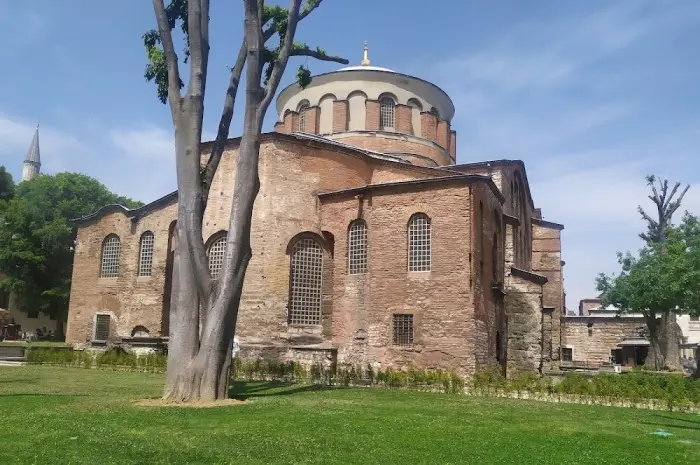
Although Hagia Sophia has undergone many changes and damage, most of the ancient mosaics depicting various religious figures, including the image of Christ, can still be found inside the building.
One of the most famous mosaics is the image of Christ located above the mihrab, which represents an important symbol for Christians.
In addition, there are also images of saints and angels decorating the walls, although most of these have been lost or erased during the transition from church to mosque.
7. Has been burned several times and received bomb attacks
Hagia Sophia has experienced several major fires. One of them occurred in 404 AD, which almost completely destroyed the building.
After the great fire, Hagia Sophia was rebuilt by Emperor Theodosios II in 415. In addition to the fire, an earthquake also caused part of the dome to collapse in 558, but the building was quickly restored in 562.
In 2016, Hagia Sophia was also affected by a bomb attack by the ISIS terrorist group near the area, which caused damage to some parts of the exterior.
8. Designated as a World Heritage Site by UNESCO
In 1985, Hagia Sophia was recognized by UNESCO as a World Heritage Site. UNESCO notes that Hagia Sophia is an important example of Byzantine architecture that greatly influenced the development of art and architecture throughout the world.
With this status, Hagia Sophia is not only considered a religious symbol, but also a valuable cultural heritage for mankind.
9. Its Influence on World Architecture
The Hagia Sophia is a prominent example of Byzantine architecture and has been a source of inspiration for many other buildings, both in the Christian and Islamic worlds.
The Hagia Sophia’s massive dome, in particular, has influenced many other great mosques around the world, including the Blue Mosque in Istanbul and the Süleymaniye Mosque designed by the famous Ottoman architect Sinan.
Its unique design and construction techniques have become a major reference for the construction of monumental buildings in the Eastern world.
10. Hagia Sophia as a Cultural Icon of Istanbul
As one of Istanbul’s most famous tourist attractions, Hagia Sophia is not only a religious symbol, but also a profound cultural icon. As a major tourist destination, it attracts millions of visitors every year, who come to enjoy its incredible architectural beauty and history.
Despite its diverse religious and cultural status, Hagia Sophia remains a symbol of peace, where religion, art and history meet to tell the long story of a timeless building.
Hagia Sophia is not just a building, but a living story that spans from the Byzantine Empire to the Ottoman Empire, and is now a symbol of peace and tolerance.
Its stunning architecture, rich history, and changing functions make the Hagia Sophia one of the most important buildings in the world.
As one of the top Tourist Attractions in Istanbul, it offers visitors a unique glimpse into the city’s diverse cultural and architectural heritage. Whether you are a visitor looking for a historical experience or just interested in architecture, the Hagia Sophia is a must-see when in Istanbul.


