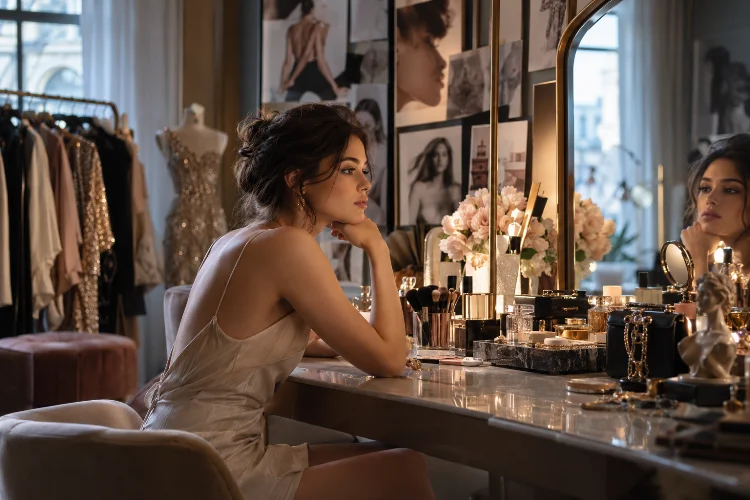
Why can a certain waistline, hairstyle, skin texture, or facial feature suddenly feel desirable – even when the same feature received little attention a decade earlier?
Female beauty ideals may look like simple matters of taste, but psychology tells a much more interesting story.
Our judgments about appearance are influenced by what we repeatedly see, who we compare ourselves with, the reactions we receive from other people, and the cultural messages we absorb from childhood.
This helps explain why appearance ideals can feel deeply personal even when they are socially constructed.
Understanding the psychology behind female appearance ideals requires looking at several processes working together. Social comparison makes people evaluate themselves against others. Internalization turns cultural preferences into personal goals.
Self-objectification encourages women to imagine how their bodies look from an outsider’s perspective, while family, peers, advertising, and social media continually reinforce certain standards.
No single theory explains everything. Together, however, these mechanisms reveal why beauty standards can become psychologically powerful – and surprisingly difficult to ignore.
Appearance Ideals Are Learned Through Social Environment
Nobody grows up completely isolated from ideas about attractiveness.
From childhood onward, people encounter comments about weight, hair, skin, clothing, facial features, and femininity.
Family members may praise certain appearances. Friends discuss celebrities, while movies, advertising, and social platforms repeatedly show particular types of women.
One influential framework, the Tripartite Influence Model, identifies family, peers, and media as three major sources of appearance pressure. Research suggests these influences affect body image partly through comparison and the internalization of cultural ideals.
The important word is learning.
A society does not need to explicitly announce that one body type is ideal. Repetition can do the work.
If the same narrow range of bodies repeatedly receives admiration, romantic attention, luxury products, and social approval, people begin learning which features supposedly deserve higher value.
Beauty standars can therefore become normal without ever being formally taught.
Internalization Turns Cultural Ideals Into Personal Goals
Seeing a beauty ideal is not the same as believing you need to achieve it.
Psychologists use the term internalization to describe the process through which an external appearance standard becomes part of someone’s own beliefs and goals.
For example, a woman might understand intellectually that fashion advertising favors unusually thin models without personally wanting that body. Internalization occurs when she begins thinking, “This is how my body should look.”
This distinction helps explain why media exposure affects people differently.
A meta-analysis examining women’s social-networking use found an association between greater use and stronger internalization of the thin ideal.
Appearance-focused activities, such as viewing and interacting with photos, showed stronger relationships than general platform use.
Once an ideal becomes internalized, the psychological pressure becomes harder to escape.
The standard no longer feels like something imposed by advertising. It can start feeling like a personal preference or even a personal obligation.
Social Comparison Makes Beauty Standards Feel Personal
Humans naturally compare themselves with other people.
Comparison helps us understand where we stand socially, professionally, financially, and physically. Appearance is no exception.
The problem emerges when the comparison target is perceived as superior.
Someone scrolling through social media may compare her skin with a beauty creator, body with a fitness influencer, wardrobe with a celebrity, and facial features with digitally edited photographs—all within a few minutes.
That creates what psychologists call upward comparison.
Appearance-focused social media research consistently identifies comparison as one pathway connecting online content with body-image concerns.
Large-scale research also suggests that family, peer, and media pressure can encourage ideal internalization and increased body surveillance.
The comparision is often unfair from the beginning.
People typically compare their ordinary reflection with someone else’s selected image – complete with flattering lighting, styling, makeup, posing, editing, and possibly cosmetic treatments.
Yet emotionally, that difference is surprisingly easy to forget.
Self-Objectification Changes How Women See Their Own Bodies
Another useful psychological theory is Objectification Theory.
The basic idea is that repeated exposure to environments where women’s bodies are constantly evaluated can encourage women to adopt an observer’s perspective toward themselves.
Instead of mainly experiencing the body from the inside – through movement, comfort, strength, hunger, energy, or health – a person may increasingly think about how the body appears to other people.
This is known as self-objectification.
A major review of experimental research describes appearance monitoring and perceived gaps between the actual body and cultural standards as important mechanisms involved in self-objectification. Body shame has also frequently appeared as an outcome.
Research involving more than 50 studies has additionally found a moderate association between self-objectification and disordered eating, although correlation alone does not prove that one directly causes the other.
This theory helps explain why appearance pressure can become exhausting.
The mirror is no longer just something you occasionally look into. In a psychological sense, you may begin carrying an imagined mirror everywhere.
Perfectionism Can Turn Beauty Preferences Into Constant Pressure
Wanting to look attractive is not automatically unhealthy.
The problem becomes more serious when attractiveness becomes a perfectionistic standard.
Perfectionism can make small differences between an actual and ideal appearance feel like failures. Instead of thinking, “I would like clearer skin,” someone may believe, “My skin must look flawless before I can feel confident.”
Research has identified maladaptive perfectionism as one factor associated with body-image dissatisfaction.
Modern beauty culture can amplify this mindset because many ideals are incredibly specific.
The desired body may need to be slim but curvy. Skin should look flawless but natural. Makeup should be visible enough to improve features while appearing effortless. Aging should supposedly be prevented without appearing to have had cosmetic work.
Those contradictory expectations create a target that keeps moving.
Perfectionisim thrives when “good enough” is never considered beautiful enough.
Social Approval Reinforces Certain Appearance Ideals
Beauty standards survive partly because appearance can produce real social feedback.
Compliments, romantic attention, likes, comments, job-related impressions, and other forms of approval can reinforce particular grooming or appearance behaviors.
Social media makes that feedback measurable.
A photograph receives 500 likes. Another receives 80. A certain hairstyle attracts compliments, while a different look receives little attention.
Over time, these reactions can teach people which version of themselves appears most socially rewarded.
Algorithms may strengthen the process by repeatedly showing users content similar to material they previously watched or engaged with. This creates an algoritmic environment where certain faces and bodies can appear much more common than they really are.
The wider media system matters too.
A 2026 analysis covering 25 years of fashion shows, advertising, and magazine covers found that demographic representation had become more diverse while the aspirational body ideal remained relatively stable.
Seeing more kinds of people does not necessarily mean the underlying appearance hierarchy has completely disappeared.
Biology May Influence Attraction, but Culture Shapes the Details
Psychology also asks whether some beauty preferences have biological or evolutionary components.
Researchers have investigated traits such as facial symmetry, averageness, youthfulness, sexual dimorphism, body proportions, and apparent health. Some cross-cultural agreement exists in judgments of attractiveness.
However, simple claims that beauty is “biologically programmed” go too far.
Evidence connecting supposedly attractive female facial characteristics with underlying health or fertility is often mixed. A review focusing on women’s facial attractiveness found inconsistent evidence for many proposed biological signals.
Culture clearly matters as well.
A comprehensive review of aesthetic preferences found substantial differences across countries and ethnic groups in desired facial proportions, breasts, body shapes, and cosmetic goals.
It also found that universal formulas such as a single facial “golden ratio” do not adequately represent diverse beauty preferences.
The most realistic explanation is therefore interactive.
Humans may share some broad perceptual tendencies, but societies strongly influence which features receive emphasis, what they symbolize, and how intensely people pursue them.
Why Beauty Ideals Keep Changing
If appearance ideals were purely biological, fashion history would be much less dramatic.
Instead, desirable bodies and faces change constantly.
One decade may celebrate extreme thinness. Another prefers visible curves. Eyebrows move from thin to thick.
Tanned skin becomes fashionable in societies that once praised paleness, while hairstyles, lip proportions, cosmetic procedures, and fitness ideals shift with celebrities and media.
Psychologically, this happens because beauty is partly a social signal.
People notice what receives status and attention, imitate influential figures, compare themselves with peers, and gradually normalize the new appearance.
Then the cycle begins again.
This also explains why no beauty trend should automatically be treated as an objective measure of attractiveness. What feels completely natural today may look surprisingly dated twenty years from now.
The psychology behind female appearance ideals is not explained by one simple force.
Social comparison helps people evaluate their appearance against others. Internalization turns cultural standards into personal goals, while self-objectification can make women monitor themselves through an imagined observer’s eyes.
Family, peers, media, social rewards, and perfectionism can strengthen those pressures further.
Biology may influence some aspects of attraction, but culture determines much of how beauty is interpreted, emphasized, and transformed over time.
Recognizing these psychological mechanisms does not require rejecting fashion, makeup, fitness, or beauty altogether. Instead, it makes it easier to ask a valuable question: Do I genuinely like this ideal, or have I simply learned that I am supposed to?
That question can completely change how we understand beauty.