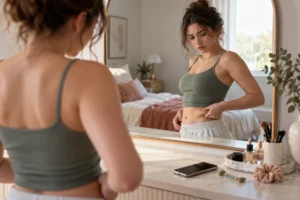
You open Instagram for a quick scroll and see someone with flawless skin. A few videos later, another person has the “perfect” waist, while a fitness creator seems stronger, leaner, and more disciplined than you feel that morning.
Nothing directly tells you that your own body is inadequate. Still, the comparison can happen almost automatically. Psychologists have been studying this tendency long before social media existed.
In 1954, psychologist Leon Festinger proposed Social Comparison Theory, arguing that people often evaluate themselves by comparing their abilities, opinions, and characteristics with those of others.
Modern psychology distinguishes between upward, downward, and lateral comparisons.
Understanding how Social Comparison Theory explains modern body image pressures helps make sense of Instagram, TikTok, fitness culture, filters, and influencer marketing.
Social media did not create our tendency to compare ourselves. It simply provides a nearly endless supply of people, bodies, and faces against which that comparison can occur.
What Is Social Comparison Theory?
Social Comparison Theory starts with a fairly simple idea: people do not evaluate themselves in isolation.
We often need reference points.
Someone wondering whether they are successful may compare careers. Someone evaluating athletic ability might compare performance with teammates. When the topic is appearance, people may compare weight, skin, facial features, hair, fitness, clothing, or body proportions.
The American Psychological Association describes three common directions of comparison. Upward comparison involves comparing yourself with someone you perceive as better off.
Downward comparison involves someone perceived as worse off, while lateral comparison involves someone viewed as roughly similar.
These comparisons are not automatically unhealthy.
An upward comparison can sometimes provide inspiration. The problem begins when the comparison creates a repeated sense that your actual appearance is failing to match an ideal you believe you should achieve.
Upward Comparison Is Especially Important for Body Image
Imagine following a fitness creator whose body represents everything you want yours to become.
The comparison may initially feel motivating.
But if that creator appears leaner, more muscular, better dressed, and more confident every single day, inspiration can gradually become self-criticism. Instead of thinking, “That gives me ideas,” you may start thinking, “Why don’t I look like that?”
Research generally finds what psychologists call a contrast effect: people often evaluate themselves less positively after comparing themselves with someone they see as superior.
APA’s review of decades of social comparison research found that people frequently select upward comparison targets and often feel worse afterward, although the outcome depends on circumstances.
Appearance makes this particularly complicated because the target may not be realistic.
You may be comparing an ordinary morning reflection with someone else’s best photograph from an entire week.
Social Media Creates an Almost Endless Comparison Pool
Before social media, most people compared themselves mainly with relatives, classmates, coworkers, neighbors, celebrities, or people encountered through traditional media.
Now the reference group is potentially global.
A teenager can compare her appearance with a celebrity in Los Angeles, an influencer in Seoul, a fitness model in Sydney, and a classmate from school within five minutes.
A 2025 systematic review and meta-analysis covering 83 studies and 55,440 participants found a significant association between greater online social comparison and body image concerns.
Higher comparison was also associated with more eating-disorder symptoms and lower positive body image.
That does not mean social media affects everyone in exactly the same way or proves that every comparison causes body dissatisfaction.
It does show that the relationship is substantial enough to appear repeatedly across a large research literature.
Filters Make Upward Comparison Even Less Fair
Social comparison has another problem online: the person on the screen may not actually look like the image being compared.
Lighting, posing, makeup, filters, photo editing, cosmetic procedures, and selective posting can dramatically alter appearance.
Even without traditional editing, people generally upload photographs in which they believe they look good.
The comparison is therefore uneven.
One person evaluates their everyday body against someone else’s carefully selected presentation. Yet the brain may still process that polished image as a meaningful reference point.
Experimental and longitudinal meta-analyses have found that exposure to idealized appearance images on social media can negatively affect body image. In experimental studies, appearance-ideal content had a moderate negative effect compared with non-appearance content.
Modern body pressure is therefore partly a problem of unrealistc reference points.
Influencers Can Feel More Comparable Than Traditional Celebrities
People have compared themselves with models and movie stars for decades.
Influencers add a different psychological element: relatability.
A famous Hollywood actor may seem obviously distant from everyday life. An influencer, however, may post breakfast, workouts, shopping trips, relationships, and bedroom conversations while speaking directly into a phone.
That familiarity can make comparison feel more relevant.
Research involving young female Instagram users found that upward comparison with both peers and influencers played an important role in the relationship between Instagram use and body dissatisfaction.
This helps explain why “ordinary” creators can sometimes generate surprisingly strong appearance pressure.
They appear reachable.
If a celebrity body seems unattainable, people may dismiss it as part of fame. But when someone of the same age appears to have perfect skin, fashionable clothes, and an ideal body while supposedly living a normal life, the comparision can feel more personal.
Fitness Content Can Blur Health and Appearance Pressure
Fitness culture provides a good example of how upward comparison can look positive on the surface.
A feed full of workouts, meal preparation, running routines, and strength training may encourage healthy behavior.
But “fitspiration” content can also repeatedly emphasize visible abs, low body fat, muscular definition, or dramatic transformations. The implied message can shift from “exercise is good for you” to “a good body should look like this.”
Experimental research has found that viewing fitspiration images can reduce body satisfaction and body appreciation for both women and men.
Social Comparison Theory helps explain why.
The viewer is not simply learning an exercise. They may also be measuring their current body against the body demonstrating it.
This distinction matters because health is much broader than whether someone visually resembles a fitness creator.
Likes and Algorithms Can Make Certain Bodies Seem More Normal
Social platforms do not display people randomly.
Algorithms prioritize content based on engagement, viewing behavior, interactions, and numerous other signals.
If a user repeatedly watches weight-loss videos, makeup transformations, gym content, or fashion creators, the platform may serve more of the same.
The result can be an algoritmic distortion of reality.
A particular body type may appear repeatedly until it begins to feel common, even if it is relatively unusual offline.
Likes, comments, shares, and follower counts add another layer. They provide visible social approval.
A highly edited image with millions of views does not merely say, “Here is one person’s appearance.” It can seem to say, “Millions of people agree this appearance is desirable.”
Social comparison becomes mixed with social validation.
TikTok Can Intensify Rapid Appearance Comparison
TikTok adds another element: speed.
Users can move through dozens of bodies and faces in only a few minutes. Fitness transformations, skincare results, “glow-ups,” cosmetic procedures, fashion videos, and dieting content can appear one after another.
A study of teenage TikTok users in Saudi Arabia reported high levels of social comparison and found that more than half of the users surveyed expressed negative body image, although some specific statistical relationships in the study were weak or nonsignificant.
This illustrates an important point.
Not every person who uses TikTok develops body dissatisfaction, and simply measuring screen time does not capture the whole picture.
What people actually view matters.
A feed dominated by comedy, animals, science, or hobbies creates a different comparison environment from one dominated by weight loss and appearance transformations.
Comparison Can Affect More Than Body Satisfaction
Body comparison can influence behavior as well as feelings.
A systematic review of social media and young adults found associations between image-focused engagement and body dissatisfaction, dieting or food restriction, overeating, and other food-related behaviors.
Participants also described deliberately modifying their appearance to match perceived ideal images.
This is why body image pressure should not be reduced to simple insecurity.
Repeated dissatifaction can influence how people eat, exercise, photograph themselves, dress, socialize, or seek cosmetic treatments.
Another research review has linked appearance-focused social media use with self-objectification – the tendency to view and monitor one’s body partly from an outsider’s perspective.
The person effectively becomes both the body being judged and the judge watching it.
Social Comparison Is Not Always Harmful
The theory does not say that every comparison makes people miserable.
Context matters.
Seeing someone’s progress can be motivating when the goal feels achievable and when the viewer does not interpret the other person’s success as evidence of personal failure.
Body-positive content can also change the comparison environment.
In an experiment involving 205 adult women, participants who viewed body-positive Instagram posts reported higher body appreciation and satisfaction than women exposed to thin-ideal or appearance-neutral content.
Other research has found improvements after people followed body-positive or appearance-neutral social media pages.
In other words, changing what fills the comparison pool can change how comparison feels.
How to Reduce Unhealthy Appearance Comparison
Social Comparison Theory suggests that one practical solution is not necessarily abandoning social media completely.
Instead, it can help to become more intentional about the reference points entering your feed.
Notice which accounts consistently trigger appearance comparisons rather than simply asking how many hours you spend online.
Unfollowing or muting highly triggering accounts, following creators with varied bodies, and adding appearance-neutral interests can make the feed less dominated by physical evaluation.
Media literacy can help too.
A randomized controlled trial involving 892 adolescents evaluated a social-media-literacy program designed partly to reduce appearance-ideal internalization and upward comparison.
The research provides evidence that teaching young people to analyze social media critically may help reduce some body-image risks.
The goal is not to stop noticing other people.
Humans compare.
The more realistic goal is recognizing when comparison has stopped providing useful information and started functioning as a constant measurement of self-worth.
Social Comparison Theory explains modern body image pressures remarkably well because today’s media environment gives people more opportunities to compare themselves than ever before.
Upward comparison can turn influencers, fitness creators, celebrities, friends, and even strangers into reference points.
Filters, selective posting, algorithms, and visible social approval can then make those reference points look more realistic and important than they actually are.
But comparison is not destiny.
Research suggests that body-positive content, media literacy, more diverse feeds, and greater awareness of edited imagery can support healthier body perceptions.
The next time scrolling leaves you suddenly unhappy with your appearance, ask one simple question: Who did I just compare myself with? Understanding that comparison may reveal more about the pressure you feel than the mirror ever could.