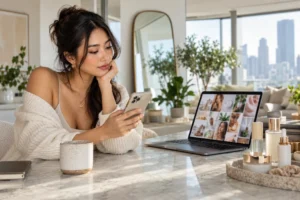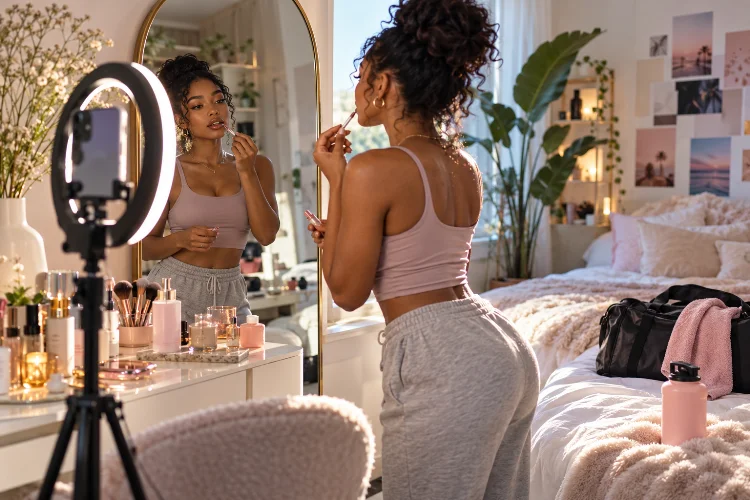
Open TikTok for five minutes and you might encounter a “glow-up,” a glass-skin routine, a gym transformation, a makeup hack, a facial filter, and someone explaining which features are supposedly attractive this month.
Individually, those videos may seem harmless. Together, they can create a surprisingly powerful environment for judging appearance.
Understanding the impact of TikTok beauty trends on self-image requires looking beyond any single influencer or viral challenge.
TikTok’s For You feed learns from interactions such as watch time, likes, shares, comments, follows, favorites, and searches to personalize future recommendations. That means users can gradually receive more of the appearance-related content that captures their attention.
This does not mean TikTok automatically damages body image. Users can encounter supportive communities, practical beauty advice, diverse bodies, and body-neutral messages too.
The bigger issue is repetition. When particular faces, bodies, and beauty routines appear again and again, they can start influencing what users perceive as normal, desirable, or personally necessary.
The For You Feed Can Create a Personal Beauty Bubble
TikTok does not show every user the same beauty culture.
Its For You feed is personalized. TikTok explains that its recommendation system considers signals such as whether users watch a video to completion, like it, share it, comment, favorite it, follow an account, or search for related topics.
That personalization can be useful. Someone interested in curly-hair care can quickly discover specialized creators, while another user may find makeup techniques for a particular skin type.
But personalization can also create a beauty bubble.
If someone repeatedly watches weight-loss transformations, skincare videos, or cosmetic-procedure content, the system may infer interest and recommend similar videos.
Attention driven by insecurity can therefore look almost identical to enthusiasm from the platform’s perspective.
The algorithim does not necessarily know why someone watched.
It mainly learns that they did.
Viral Trends Can Make Unusual Features Feel Normal
Repetition influences perception.
Imagine seeing hundreds of women with very narrow waists, extremely clear skin, defined jawlines, full lips, or identical makeup styles. Even if these features are relatively uncommon offline, repeated exposure can make them feel normal.
TikTok’s short-form format accelerates that process because users can encounter dozens of appearance-focused videos in a short session.
Research involving 778 young adult women found that TikTok use was indirectly associated with body dissatisfaction through greater upward appearance comparison followed by increased body surveillance.
That pathway is important.
The issue is not simply seeing a beautiful person. It is repeatedly measuring your own appearance against people you perceive as more attractive and then monitoring your body more closely afterward.
The more frequently an ideal appears, the easier it becomes to confuse digital visiblity with real-world normality.
Beauty Content Can Trigger Upward Social Comparison
TikTok is designed around discovery, which means users constantly encounter people they do not personally know.
That creates endless opportunities for social comparison.
A woman may compare her skin to a beauty creator, her body to a fitness influencer, her makeup to a professional artist, and her hair to someone who spent hours styling it – all during one scrolling session.
An experiment with 115 young women found that those exposed to TikTok beauty videos experienced greater face-related appearance shame and anxiety and more negative mood than participants who watched travel or self-compassion content.
They also engaged in upward appearance comparison.
The comparision is rarely equal.
One person sees herself under ordinary bathroom lighting while comparing that image with someone else’s best angle, carefully selected outfit, makeup, professional lighting, and possibly edited footage.
TikTok can make that polished version feel casual, which may make it seem more achievable than it really is.
Beauty Filters Can Blur the Line Between Face and Ideal Face
Filters add another layer because they do not simply show someone else’s idealized appearance.
They can modify the user’s own face.
Modern filters may smooth skin, reshape the jaw, enlarge lips, alter eyebrows, adjust the nose, or subtly change facial proportions.
Research examining TikTok’s Bold Glamour filter found measurable changes to features including lip fullness, nasal appearance, eyebrows, cheeks, and jaw structure.
Another study involving TikTok users found that greater use of appearance-enhancing facial filters was associated with more facial dissatisfaction and broader body-image concerns. Because the study was correlational, it cannot establish that filters directly caused those concerns.
Interestingly, a 2026 experiment found that idealized TikTok videos affected mood and facial satisfaction in some conditions, but filtered videos were not clearly more harmful than similarly idealized unfiltered videos.
That suggests the deeper issue may sometimes be idealization itself – not simply the presence of a filter.
Fitspiration Can Turn Health Content Into Appearance Pressure
TikTok fitness content often presents itself as motivational.
Some of it genuinely is.
Users can find strength-training tutorials, running advice, mobility exercises, and supportive communities. But fitspiration can also blur the distinction between being healthy and looking a certain way.
A 2024 content analysis of 200 popular TikTok fitspiration videos found that women’s content frequently included thin and fit body ideals, body-part objectification, and appearance-focused reasons for exercising.
Researchers also judged 60% of the videos as containing incorrect or potentially harmful information.
Experimental research has found similar concerns. Young women exposed to fitspiration TikTok videos reported higher levels of appearance comparison, body dissatisfaction, and negative mood than control groups.
The problem is not exercise.
It is the idea that exercise has only “worked” when someone’s body looks like the body being presented on screen.
Extreme Diet Content Can Have Faster Effects Than People Expect
Not every beauty trend stays within makeup or skincare.
TikTok can also expose users to dieting, weight-loss challenges, “what I eat in a day” content, and videos that indirectly or explicitly glamorize disordered eating.
An experimental study involving 273 women aged 18–28 found that a brief exposure to pro-anorexia TikTok content produced a greater decline in body-image satisfaction and stronger internalization of societal beauty standards than neutral content.
A separate study analyzing more than one million TikTok videos delivered to people with eating disorders and healthy controls found major differences in recommendations.
Accounts belonging to participants with eating disorders received substantially more appearance, dieting, exercise, and toxic eating-disorder content.
These findings should not be interpreted as proof that TikTok causes eating disorders.
They do show why personalized recommendation systems deserve attention when a user is already vulnerable to appearance or eating concerns.
Body Positivity Helps, but the Label Is Not Always Enough
TikTok also contains communities that deliberately challenge narrow beauty standards.
Body-positive creators may show stretch marks, larger bodies, acne, disabilities, scars, or ordinary changes in appearance. Body-neutral creators often go further by arguing that a person’s value does not need to depend on feeling beautiful at all.
Experimental research published in 2025 found that brief exposure to body-positive and body-neutral TikTok content improved several outcomes, including body dissatisfaction and negative affect.
Body-neutral content was particularly helpful in reducing self-objectification compared with weight-stigmatizing content.
However, the hashtag alone does not guarantee diversity.
A content analysis of 342 body-positive TikTok videos found that around 93% still reflected Western beauty ideals to some degree, while only about one-third explicitly contained positive body-image messages.
So even movements designed to challenge beauty norms can sometimes reproduce them.
TikTok Can Make Beauty Trends Change Extremely Fast
Traditional beauty trends might once have developed over years.
TikTok can compress that process into months or weeks.
One aesthetic becomes popular, creators copy it, users search for tutorials, brands respond with products, and soon the look appears everywhere. Then another trend replaces it.
This creates a moving target.
Thin eyebrows become thick brows. Matte makeup becomes glossy skin. One body ideal becomes another. A facial feature that was barely discussed suddenly receives a name, dozens of tutorials, and thousands of transformation videos.
For users who strongly internalize beauty trends, this constant change can create the feeling that appearance always needs another upgrade.
The pressure becomes less about achieving one perfect look and more about continually keeping up.
That can make ordinary features feel outdated simply because a new trend has made something else more visible.
A Healthier TikTok Feed Is Possible
The strongest takeaway from current research is not necessarily “delete TikTok.”
Content matters.
Passive TikTok use was negatively associated with appearance and weight esteem in a study of 7,750 female users in China, while more active use showed a different pattern. Social comparison helped explain some of these relationships.
Users can also influence their For You feed.
TikTok says people can use features such as “Not interested,” unfollow accounts, search for different subjects, or refresh their For You feed to alter future recommendations.
A practical strategy is to notice how content makes you feel rather than only whether it is entertaining.
If certain creators repeatedly leave you criticizing your face or body, that reaction is useful information.
Adding hobbies, comedy, education, body-neutral creators, and diverse appearances can make the feed less dominated by one exagerated beauty standard.
TikTok beauty trends can influence self-image because the platform combines rapid video consumption, personalized recommendations, social comparison, filters, fitness culture, and constantly changing appearance ideals.
That influence is not automatically negative. TikTok can spread useful skincare knowledge, introduce diverse creators, and provide body-positive or body-neutral spaces that challenge traditional standards.
Problems are more likely when idealized appearances become repetitive enough to seem normal and when users begin measuring themselves against carefully curated digital bodies and faces.
The next time your For You feed suddenly makes one feature feel inadequate, consider the source before blaming the mirror.
Pay attention to what you watch, what you compare yourself with, and what the algorithm keeps returning. Changing those inputs can help make TikTok a source of discovery rather than a permanent appearance test.