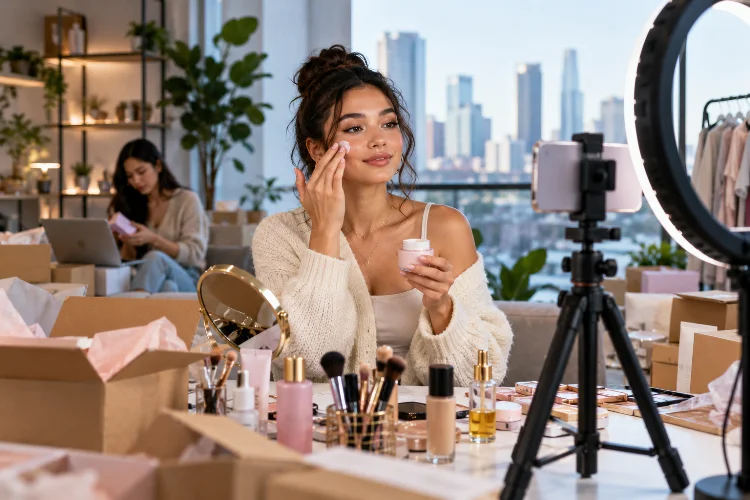
A beauty trend can now cross the planet before most people even know where it started. A skincare technique developed in Seoul might become popular in Los Angeles, appear in tutorials from Jakarta, and reach European beauty stores within months – or sometimes weeks.
That speed is something genuinely new.
Beauty ideas have always traveled through migration, trade, fashion, film, and celebrity culture. What has changed is the infrastructure carrying them.
Social platforms, global retailers, creators, online marketplaces, streaming entertainment, and international cosmetic companies allow an aesthetic to move between cultures almost instantly.
Understanding the global spread of contemporary beauty trends therefore involves more than tracking popular makeup or hairstyles. It means looking at the systems that make a look visible, desirable, purchasable, and easy to imitate.
Interestingly, this does not mean everyone is becoming identical. Modern beauty trends often become global first and then change again locally. The result is a constantly moving mixture of international influence, cultural adaptation, commercial marketing, and individual expression.
Social Media Has Dramatically Accelerated Beauty Trends
Beauty trends once depended heavily on magazines, television, fashion shows, and celebrity photographs.
Today, almost anyone can start one.
TikTok, Instagram, YouTube, and similar platforms allow makeup artists, dermatologists, hairstylists, celebrities, brands, and ordinary consumers to reach international audiences without passing through traditional media companies.
A systematic review published in 2024 found that exposure to idealized and digitally enhanced images on social media can affect body dissatisfaction and attitudes toward cosmetic procedures. The review included 25 studies involving more than 13,000 participants.
The important point is not simply that social media influences beauty.
Platforms also accelerate repetition. Once a particular hairstyle, lip shape, skincare routine, or body aesthetic receives strong engagement, algorithms can recommend similar content repeatedly.
That can make a niche aesthetic look universal remarkably quickly.
The algoritms effectively compress geography.
Influencers Turn Global Trends Into Personal Recommendations
Traditional beauty advertising often feels obviously commercial.
Influencer content can feel different.
When creators demonstrate a product during a daily routine, explain a technique, or compare affordable alternatives, international trends begin to feel more personal and accessible.
Beauty brands understand this.
However, creator marketing is becoming more complicated. McKinsey’s 2025 consumer research found that beauty inspiration does not come exclusively from social media; physical retail, family and friends, and online retail also remain important discovery channels.
It also found that consumers are becoming more skeptical about hype and increasingly focused on product performance.
This means influeners may introduce a trend, but consumers still compare reviews, prices, ingredients, and recommendations before adopting it.
That is important for understanding modern beauty culture.
Trends spread quickly, but staying power depends on whether people actually find them useful, attractive, or relevant.
K-Beauty Shows That Trends No Longer Move Only From West to East
Global beauty used to be discussed largely as the international spread of European and American fashion.
That model is now outdated.
K-beauty demonstrates why.
South Korean skincare, lightweight makeup, cushion foundations, sheet masks, cleansing routines, and glowing-skin aesthetics have achieved enormous international visibility.
The numbers illustrate how far that influence has traveled.
South Korea’s cosmetics exports reached a record USD 11.4 billion in 2025, according to government figures, with the United States, China, and Japan among its largest markets. Korean products were exported to more than 200 destinations.
This matters culturally as well as economically.
Ideas can now travel from Seoul to New York, Bangkok, London, Jakarta, and Paris, influencing both consumers and competing brands.
The same principle applies elsewhere. Japanese cosmetics, African hair culture, South Asian beauty traditions, Latin American aesthetics, and Middle Eastern makeup styles can all reach audiences beyond their original regions.
Contemporary beauty has become multidirectional.
E-Commerce Turns Inspiration Into Instant Consumption
Seeing a beauty trend is only half of the story.
People also need access to the products required to reproduce it.
E-commerce has dramatically shortened the distance between discovery and purchase. Someone can watch a skincare demonstration, search for the product, compare reviews, and place an international order without leaving the platform ecosystem.
McKinsey expects online channels to represent nearly one-third of global beauty sales by 2030, compared with around 26 percent in 2024.
Its 2026 industry research also highlights the growing role of creators, social commerce, digital marketplaces, and increasingly fluid shopping behavior.
This changes how trends develop.
In previous decades, consumers might read about a foreign product but struggle to find it locally. Today, global marketplaces can make products available before domestic retailers even recognize the trend.
Beauty culture has effectively become linked to a worldwide distribution network.
Global Brands Adapt Trends to Local Markets
Globalization does not mean selling exactly the same appearance everywhere.
Major beauty companies increasingly understand that consumers have different climates, skin tones, hair textures, traditions, budgets, and routines.
L’Oréal describes its international strategy as “Universalization,” meaning that the company aims to maintain global scale while adapting products to regional needs.
Its research and innovation network includes strategic hubs serving markets such as the United States, Japan, Brazil, China, India, and South Africa.
This type of localizaton helps explain why international trends often look slightly different in each country.
A dewy foundation popular in a cooler climate may require a different formulation for tropical humidity. Haircare trends have to account for different textures. Foundation launches need shade ranges suited to regional consumers.
The trend travels globally, but the final version may become distinctly local.
Cosmetic Procedures Have Become Part of Global Trend Culture
Contemporary beauty trends increasingly extend beyond makeup and skincare.
Aesthetic procedures are now part of the international beauty conversation.
The International Society of Aesthetic Plastic Surgery reported more than 35 million surgical and non-surgical aesthetic procedures worldwide in 2025. Eyelid surgery was the most common surgical procedure, while botulinum toxin remained the leading non-surgical treatment.
Social media helps make these procedures more visible.
Before-and-after images, clinic videos, celebrity speculation, recovery diaries, and discussions of fillers or facial surgery allow users in different countries to encounter similar aesthetic possibilities.
This does not mean people everywhere request identical results.
Regional preferences still matter. Eyelid procedures, rhinoplasty, body contouring, injectables, and other treatments can have different levels of popularity depending on local culture.
What has become global is the idea that medical procedures can participate in beauty trends alongside cosmetics, fashion, and skincare.
Greater Diversity Does Not Always Mean Broader Beauty Ideals
Modern beauty media appears more diverse than it did several decades ago.
There are more visible skin tones, ethnic backgrounds, body types, ages, and cultural identities in advertising and fashion.
But greater representation does not automatically mean the underlying ideal has completely changed.
A 2026 study examining 25 years of fashion shows, advertisements, and magazine covers found an interesting contradiction. Representation became more diverse, yet the aspirational body standard remained comparatively stable.
The researchers described a pattern where diversity could increase without fundamentally changing the body type positioned as ideal.
This helps explain something viewers may notice online.
Feeds can contain women from many different ethnic groups while still favoring similar facial proportions, smooth skin, slim bodies, youthful appearances, or carefully styled features.
Global beauty culture can therefore become more diverse visually while remaining surprisingly narrow structurally.
Digital Filters Make Some Trends Almost Impossible to Achieve Naturally
Another factor shaping worldwide beauty expectations is image editing.
Filters can smooth skin, enlarge eyes, alter lips, reshape noses, sharpen jawlines, brighten complexions, and modify facial proportions within seconds.
After seeing filtered appearances repeatedly, users may begin treating digitally constructed features as normal.
Research on social media and body image has linked repeated exposure to idealized online imagery with appearance comparison and body dissatisfaction, particularly among younger users.
Social platforms can also support body-positive communities, showing that digital culture can challenge beauty pressure as well as reinforce it.
This creates one of the strangest features of contemporary beauty.
A trend may begin digitally, influence real-world makeup, inspire cosmetic treatments, and then return to social media in an even more polished form.
The online and offline versions of beauty continuously reinforce each other.
Local Cultures Still Remix Global Beauty Trends
Despite the enormous reach of global media, local beauty culture is not disappearing.
People select, reject, and modify international influences.
A consumer in Indonesia might combine Korean skincare with locally popular modest fashion. Someone in Brazil may follow an international makeup trend while adapting it to regional body aesthetics and climate.
A European consumer might adopt Japanese skincare while maintaining completely different preferences in hair or clothing.
That process creates cultural hybrids.
Even global companies increasingly recognize this fragmentation. McKinsey’s recent beauty research argues that companies need stronger understanding of individual markets because consumer tastes vary significantly by country and demographic group.
This is why the future of beauty probably will not involve one global face.
Instead, we are likely to see more overlapping micro-trends, each spreading internationally before being altered by regional preferences.
Beauty Trends Are Moving Faster, but Consumers Are Becoming More Selective
Speed does not guarantee permanence.
Social platforms produce enormous numbers of micro-trends, from specific makeup finishes to hairstyles, nail designs, skincare ingredients, and aesthetic “cores.”
Many disappear almost as quickly as they appear.
Consumers are also becoming harder to impress. McKinsey’s research suggests that beauty shoppers are increasingly concerned with efficacy, quality, and value rather than novelty alone.
That may influence the next stage of global beauty.
The most successful trends may not simply be the most visually viral. They may need to deliver practical results, suit multiple markets, and survive consumer skepticism.
This could create greater diversitiy in the long term because brands can no longer assume one fashionable look or celebrity campaign will work everywhere.
The global spread of contemporary beauty trends is driven by a powerful combination of social media, influencers, entertainment, e-commerce, international brands, cosmetic procedures, and increasingly connected consumers.
A trend can begin locally and reach a worldwide audience almost instantly. K-beauty is a clear example, but similar cultural exchanges now happen in multiple directions.
At the same time, globalization has not produced one universal beauty standard. Local cultures continue to reinterpret international trends according to climate, identity, history, skin tone, lifestyle, and personal preference.
The next time a beauty look suddenly appears everywhere, look beyond the trend itself.
Ask where it started, which platforms amplified it, which brands commercialized it, and how different communities adapted it. That journey often reveals more about modern culture than the beauty trend alone.