You open social media for a few minutes and suddenly everyone seems to have clearer skin, better clothes, a smaller waist, stronger legs, or a more polished lifestyle.
Nothing explicitly tells you that you should look the same, yet the comparison can happen almost automatically. That is where social media comparison becomes powerful.
People have always compared themselves with others, but digital platforms dramatically increase the number of available comparison targets.
Instead of comparing appearance mainly with friends, coworkers, or celebrities, users can now evaluate themselves against thousands of influencers, fitness creators, models, acquaintances, and strangers.
Understanding how social media comparison reinforces appearance expectations helps explain why beauty standards can feel increasingly demanding.
Research shows that online comparison is associated with stronger body-image concerns, especially when users compare themselves upward to people they see as more attractive.
The issue is not simply seeing attractive people. It is repeatedly using idealized appearances as personal reference points.
Social Comparison Turns Beauty Into a Personal Benchmark
Social comparison is a normal psychological process.
People use others to evaluate everything from career success to athletic ability. Appearance works the same way.
On social media, these comparisons often become upward comparisons, meaning users evaluate themselves against someone they perceive as more attractive, fitter, thinner, more fashionable, or more polished.
A 2025 meta-analysis covering 83 studies and 55,440 participants found a moderate association between greater online social comparison and stronger body-image concerns. Higher comparison was also associated with lower positive body image and more eating-disorder symptoms.
That does not mean comparison always produces harm.
But when someone’s reference points are consistently people who appear “better,” the comparison can gradually turn beauty from a preference into a perceived requirement.
Curated Images Make the Comparison Unequal
Social media rarely shows ordinary reality.
People choose flattering photographs, edit lighting, select better angles, retake selfies, use makeup, pose strategically, and delete images they dislike.
The result is selective self-presentation.
Research involving social-network users has found that women tend to edit photographs more frequently and report feeling worse after upward comparison than men. Body-image concerns and comparison tendencies help explain some of these effects.
This makes online comparison fundamentally uneven.
A user may compare her everyday appearance – messy hair, normal lighting, relaxed posture – with someone else’s best image from dozens of attempts.
Yet emotionally, the brain may still treat both images as equally realistic.
The comparision feels fair even when the conditions are completely different.
Repetition Makes Narrow Beauty Ideals Feel Normal
A major reason social media reinforces appearance expectations is repetition.
If users repeatedly see similar bodies, skin textures, facial proportions, hairstyles, or fitness levels, those characteristics can begin to feel more common than they really are.
This is especially relevant on image-heavy platforms.
A 2026 study of women aged 17–30 found that more frequent use of image-based platforms such as Instagram, TikTok, Snapchat, and YouTube was associated with greater appearance comparison and stronger internalization of thin and fit ideals.
The body types shown most often do not necessarily represent the average population.
They represent what attracts attention online.
That distinction can easily disappear when the same aesthetic appears hundreds of times.
Visibility begins to look like normality.
Influencers Can Feel More Comparable Than Celebrities
Traditional celebrity culture always created appearance pressure, but influencers introduce something different: relatability.
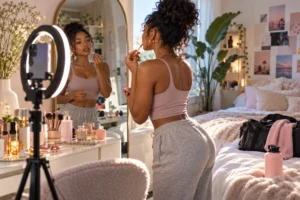
A movie star may seem obviously distant from everyday life. An influencer may film from a bedroom, complain about traffic, show breakfast, discuss relationships, and speak directly to followers.
That familiarity can make the appearance comparison feel more realistic.
Research on Instagram influencers found that exposure to sexualized influencer imagery increased appearance comparison, negative mood, and body dissatisfaction compared with standard fashion imagery. Appearance comparison helped explain part of that effect.
The influencer may therefore feel like “someone like me,” even when her appearance is supported by professional photography, sponsorships, styling, cosmetic procedures, or significant time devoted to content creation.
That perceived similarity can make upward comparison more emotionally powerful.
Likes Can Turn Beauty Into Visible Social Approval
Social media does something that traditional magazines could not: it publicly counts approval.
Likes, comments, shares, views, and follower numbers surround images with measurable social feedback.
This can make certain appearances seem socially endorsed.
An experiment involving 220 women found that thin-ideal Instagram images increased body and facial dissatisfaction compared with average-body images.
Although the number of likes did not affect every outcome, women who placed more importance on likes reported more appearance comparison and facial dissatisfaction.
This creates a subtle message.
A photograph does not simply show an attractive woman. It may also show that hundreds of thousands of people reacted positively to her appearance.
Users can begin connecting beauty with social value.
The more approval an appearance receives, the more desirable it may seem.
Comparison Can Reinforce Beauty Standards Over Time
Social comparison and body dissatisfaction appear to influence each other.
Someone who compares frequently may become less satisfied with her appearance. But dissatisfaction can also make a person search for more comparison targets.
A 2025 systematic review and meta-analysis of longitudinal research found a small but significant bidirectional relationship between appearance comparison and body dissatisfaction among women.
Daily-life research shows a similar pattern.
A seven-day study involving 315 women found that upward social-media comparisons predicted lower body satisfaction and stronger urges to restrict food intake. Lower satisfaction and related concerns could then contribute to further comparison.
This can create a self-reinforcing loop:
You feel dissatisfied, look at other people for reference, compare upward, feel worse, and become even more focused on appearance.
Over time, the expectation becomes harder to question because comparison continually confirms it.
Thin, Fit, and Curvy Ideals Can All Create Pressure
Modern appearance expectations are not limited to thinness.
Social media now promotes multiple ideals simultaneously.
Women may be encouraged to look slim but curvy, muscular but feminine, lean but not too thin, and highly groomed while appearing effortless.
Fitness content adds another layer.
Research has found that exposure to both thinspiration and fitspiration can be associated with greater body dissatisfaction in daily life.
This matters because replacing one ideal with another does not necessarily remove appearance pressure.
A supposedly “healthy” aesthetic can still become a rigid benchmark if users constantly evaluate whether their own bodies match it.
The problem is not necessarily fitness, makeup, or fashion.
It is the transformation of one appearance into a standard everyone feels expected to achieve.
Friends Can Sometimes Trigger Stronger Comparison Than Celebrities
One surprising aspect of social media is that comparison with familiar people can be especially influential.
Research among adolescent girls found that body dissatisfaction was associated with online appearance comparison, and comparisons with close friends were particularly important when girls rated themselves less favorably.
This makes sense psychologically.
A supermodel may feel unreachable.
A classmate or friend feels much more relevant.
If someone of similar age, background, and lifestyle appears thinner, more stylish, or more attractive online, the comparison may carry an implicit message: “If she can look like that, maybe I should too.”
Peer comparison can therefore make appearance expectations feel realistic rather than aspirational.
That may make them harder to dismiss.
Idealized Content Can Become Internalized
Comparison becomes even more powerful when an appearance standard moves from “something other people like” to “something I personally need.”
Psychologists call this internalization.
A meta-analytic review found that social-network use was associated with greater internalization of the thin ideal, with appearance-focused activities such as viewing and posting photographs showing stronger relationships than general platform use.
Once a beauty ideal is internalized, the pressure no longer feels external.
A user might stop thinking, “Instagram favors thin bodies,” and begin thinking, “I should be thinner.”
That psychological shift matters.
It turns a cultural expectation into a personal rule.
And personal rules are often much harder to ignore.
Appearance Expectations Can Become Self-Reinforcing Online
Social platforms are interactive environments.
Users do not only consume beauty standards; they reproduce them.
Someone sees a popular pose, copies it, edits the photograph, posts it, and receives feedback. Other users then see that content and repeat the process.
This creates cultural reinforcement.
The expectation spreads because users both respond to it and contribute to it.
A 2026 longitudinal study involving 1,999 college students found that appearance-focused social-network use predicted greater body dissatisfaction over time. Appearance comparison and internalization of appearance ideals helped explain the relationship.
This shows why contemporary beauty standards can become difficult to separate from social-media behavior.
People are not simply exposed to the ideal.
They help circulate it.
Body-Positive Content Can Change the Comparison Environment
Social media comparison is not inevitably negative.
The type of content matters.
Research on body-positive social media suggests that exposure to diverse bodies and messages challenging conventional beauty standards can support greater body satisfaction and positive mood.
A broader idea of beauty may also reduce pressure.
A 2025 longitudinal study of 1,436 women found that broader conceptualizations of beauty – recognizing diverse body types, appearances, and internal qualities as beautiful – were associated with positive body-image outcomes.
This suggests that the goal does not necessarily have to be avoiding all comparison.
Changing the comparison pool may also help.
Following people with different bodies, ages, skin textures, styles, and lifestyles can make the digital environment feel less uniformed.
How to Reduce Harmful Appearance Comparison
A useful first step is paying attention to what happens after scrolling.
Which accounts leave you inspired, and which leave you inspecting your body?
Unfollowing or muting consistently triggering accounts can reduce repeated upward comparison. It can also help to follow more appearance-neutral content—hobbies, education, comedy, art, travel, or communities where physical appearance is not the central focus.
Another useful habit is questioning the comparison itself.
Ask whether the image is edited, posed, professionally lit, or selectively posted. Consider whether the person is actually a realistic reference point.
This is not about pretending attractive people do not exist.
It is about making the mental measurment fairer.
Social media comparison reinforces appearance expectations by repeatedly turning other people’s bodies, faces, and lifestyles into reference points.
Upward comparison, curated photographs, influencers, visible likes, peer content, and idealized imagery can make narrow standards feel common and personally relevant.
Over time, those standards may become internalized, meaning users begin judging themselves according to expectations they originally encountered online.
Research also shows that the process can work in both directions: body dissatisfaction encourages more comparison, while comparison can deepen dissatisfaction.
The next time scrolling changes how you feel about your appearance, notice what happened just before that feeling. Who did you compare yourself with? Was the reference point realistic?
Changing the comparison environment may be one of the simplest ways to make social media feel less like a permanent beauty competition.