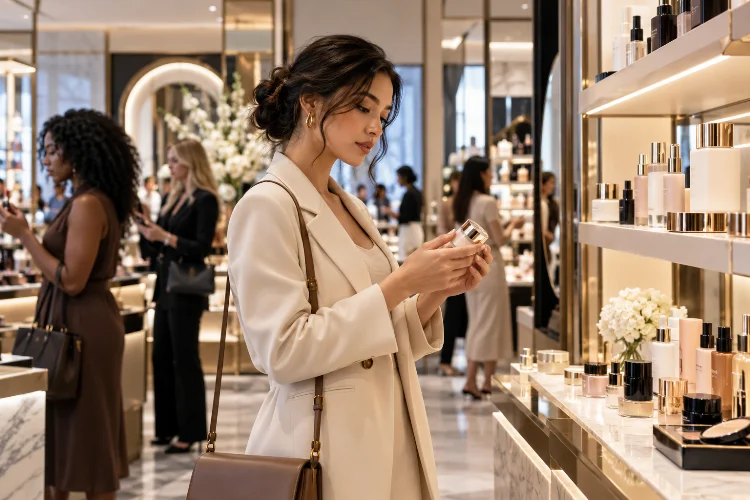
Walk into beauty stores in Jakarta, Dubai, Mumbai, Paris, or São Paulo and you may recognize many of the same global names.
The packaging, celebrity campaigns, and product categories can look familiar even when the language and consumers around them are completely different.
That global presence gives international beauty companies unusual cultural influence.
Brands do more than respond to what consumers already consider attractive. Through advertising, foundation shades, skincare terminology, influencer partnerships, product launches, and retail displays, they can also make certain looks feel more desirable, modern, or socially accepted.
At the same time, the process is rarely one-way. Successful companies increasingly adapt products and campaigns to local climates, complexions, hair textures, traditions, and consumer values.
Understanding how international beauty brands influence local aesthetic norms therefore means looking at a constant exchange between global marketing and local culture.
Sometimes brands reinforce older beauty expectations. Sometimes they challenge them. And increasingly, local trends can travel back through international companies and influence beauty culture worldwide.
Global Brands Turn Beauty Trends Into Everyday Expectations
International beauty companies have enormous distribution networks. A makeup look that once belonged mainly to one city or country can become available to millions of consumers when a large company turns it into a product category.
Think about contour kits, brow products, brightening serums, lip plumpers, cushion foundations, or glass-skin-inspired skincare.
Once global brands heavily promote a particular product, consumers do not simply receive another shopping option. They are also repeatedly exposed to the appearance that the product promises to create.
A contour product implies that certain facial definition is desirable. A brightening serum suggests that even, luminous skin should be pursued. A volumizing lip product places more attention on lip size.
This is one reason beauty marketing can subtly change local norms without explicitly saying, “This is what a beautiful woman should look like.”
Products themselves can carry that message.
Advertising Connects Certain Looks With Success
Beauty advertising is powerful because it rarely sells appearance alone.
Campaigns frequently connect appearance with confidence, romance, professional success, luxury, youth, health, or social approval.
Over time, those associations can influence how a society interprets particular features.
Research on skin-lightening advertising offers a strong example. Academic work on cosmetics marketing in India has shown how lighter skin has historically been connected in advertising with employment, marriage prospects, social mobility, and desirability.
Even after some brands moved away from explicitly using words such as “fairness,” debates continue over whether newer language about “glow” and “radiance” still carries traces of older colorist assumptions.
This demonstrates why advertisng matters culturally.
Brands do not create every prejudice from nothing. But by repeating existing preferences through polished campaigns, they can make those preferences appear normal, aspirational, and commercially validated.
Localization Prevents Global Beauty From Looking Completely Uniform
International companies have learned that simply exporting the same product everywhere is not always effective.
Consumers in different markets have different hair types, skin tones, climates, routines, budgets, and ideas about what beauty means.
L’Oréal, for example, describes its global strategy as “Universalization,” meaning that international brands are adapted around local desires, traditions, and needs.
The company operates research and innovation hubs connected to major markets including China, India, Japan, Brazil, South Africa, and the United States.
This approach creates an interesting effect.
Global companies introduce international aesthetics, but local consumers also reshape the brands.
A moisturizer sold in humid Southeast Asia may need different texture preferences from one marketed in northern Europe. Foundation ranges need to reflect different complexions. Hair products must respond to different curl patterns and grooming traditions.
Modern global beauty is therefore increasingly based on localizaton, not simple standardization.
Shade Ranges Can Change Who Is Seen as Part of Beauty Culture
Few areas show brand influence more clearly than foundation.
For decades, many mainstream cosmetic ranges offered significantly more options for lighter skin than deeper complexions.
That imbalance communicated something beyond product availability: it suggested which consumers the mainstream beauty industry considered central.
Fenty Beauty attracted major attention in 2017 partly because its foundation debuted with 40 shades and its marketing prominently featured women with different skin tones. TIME highlighted the campaign’s unusually broad representation shortly before launch.
The significance extended beyond one company.
Inclusive shade ranges became a much more visible competitive issue across the cosmetics industry. Consumers increasingly questioned brands that launched foundations with very limited options for deeper complexions.
This is a useful example of a brand helping expand an aesthetic norm rather than narrowing it.
Representation tells consumers who is allowed to appear glamorous, luxurious, fashionable, or aspirational.
When the range expands, the visual definition of mainstream beauty can expand with it.
International Brands Can Amplify Local Beauty Trends Globally
Cultural influence does not always move from Western companies toward local markets.
K-beauty is one of the clearest examples.
South Korean skincare practices, cushion foundations, sheet masks, lightweight textures, glossy complexions, and elaborate skincare routines gained huge international visibility during the past two decades.
Global companies noticed.
Ideas associated with Korean beauty were incorporated into product development, advertising language, and skincare routines far outside Korea. At the same time, Korean brands themselves expanded internationally.
Research in Indonesia has documented how the Korean Wave and social media have influenced local beauty perceptions and demand for K-beauty-related products and aesthetics.
This reverses the old assumption that global beauty automatically means Western beauty.
Today, aesthetic influence can move from Seoul to New York, Tokyo to Paris, Lagos to London, or Mumbai to Southeast Asia.
The global system has become much more multidirectional.
Influencers Make Brand Messages Feel More Personal
Traditional advertising clearly looks like advertising.
Influencer marketing is different.
When a creator demonstrates a skincare routine in her bedroom or casually recommends a lipstick while talking to followers, the message can feel more like advice from a friend than corporate promotion.
That intimacy gives international brands another pathway into local beauty culture.
Global companies regularly work with regional creators because local influencers understand language, humor, skin concerns, cultural expectations, and everyday purchasing habits better than a generic global campaign might.
The result is a hybrid message.
The brand brings international products and imagery, while the creator makes them culturally familiar.
This can accelerate trends very quickly. A product associated with dewy skin, laminated brows, glossy lips, or a particular hairstyle can move from being a niche preference to something consumers see repeatedly across their feeds.
Beauty norms become commercial, social, and algorithmic at the same time.
Global Brands Can Reinforce Colorism and Other Existing Biases
International beauty influence is not always positive.
Companies sometimes enter markets and build campaigns around inequalities that already exist.
Colorism is one of the clearest examples.
Research on skin-lightening markets has shown that lighter skin can operate as a form of social or symbolic capital in some societies, especially for women.
Globalized advertising and beauty products can reinforce these hierarchies by repeatedly connecting lighter complexions with attractiveness or opportunity.
Digital marketing adds another layer.
A 2024 study examined thousands of online skin-lightening advertisements across eight countries after Google changed its policy on discriminatory advertising. The research shows how large and internationally distributed this advertising ecosystem has become.
It is important not to blame multinational brands for every local preference.
Many beauty hierarchies existed before modern corporations arrived.
But brands have considerable power to either profit from those biases or help move consumers away from them.
Local Consumers Are Becoming Harder to Standardize
One of the biggest changes in today’s market is that consumers are becoming less willing to accept a single corporate definition of beauty.
McKinsey’s 2025 global beauty research found substantial variation not only between countries but within individual markets.
The report argues that beauty companies increasingly need hyperlocal approaches because preferences are fragmented across different consumer groups.
Consumers can also publicly challenge companies.
A poor foundation shade range can generate criticism immediately. An advertisement that appears culturally insensitive can spread across social media. Products designed without understanding local hair or skin needs can receive thousands of negative reviews.
This makes the relationship between companies and consumers more interactive.
Brands influence people, but people increasingly influence brands back.
Aesthetic norms are becoming negotiated rather than simply delivered from corporate headquarters.
Local Brands Can Push Back Against International Ideals
International companies are not the only players shaping beauty.
Local brands can deliberately position themselves as alternatives to imported ideals.
Research on Indonesian brands, for example, shows how domestic companies can use local cultural values, heritage, natural ingredients, and regional beauty narratives to construct their own definitions of attractiveness.
This does not automatically mean local marketing is more inclusive.
Local brands can reproduce their own class, ethnic, or skin-tone hierarchies.
Still, competition between international and domestic companies increases the number of beauty narratives available to consumers.
Instead of one global standard replacing everything else, markets often develop a mixture of imported fashion, local tradition, celebrity culture, religious values, and regional identity.
That diversitiy makes contemporary beauty much harder to describe with a single formula.
The Future Is Likely to Be Global but Hyperlocal
The beauty industry is becoming more international while simultaneously becoming more specific.
This sounds contradictory, but it makes sense.
A major brand may operate in 100 countries while using different ambassadors, shades, product textures, campaign language, and cultural references in each market.
McKinsey’s 2026 industry analysis points toward increasingly fragmented consumer behavior and growing importance for social commerce, creators, and personalized discovery.
That means the most influencial global beauty companies may not be those that impose one appearance everywhere.
They may be the companies best able to identify local preferences, translate them into products, and occasionally turn those local ideas into international trends.
In that system, Tokyo, Lagos, Jakarta, Mumbai, Seoul, Paris, Dubai, and São Paulo can all become sources of global beauty influence.
International beauty brands influence local aesthetic norms through far more than cosmetics alone.
Advertising, product categories, shade ranges, celebrity partnerships, influencer campaigns, and retail availability can all affect which features receive attention and which appearances become aspirational.
However, global influence does not automatically erase local culture.
Successful brands increasingly adapt to regional skin tones, climates, traditions, values, and consumer expectations. At the same time, local trends such as K-beauty can travel outward and reshape international markets.
The result is a beauty culture built through constant exchange.
Next time a particular look suddenly seems “normal,” look at the products, campaigns, creators, and companies surrounding it.
You may find that beauty preferences are not simply changing on their own – they are being marketed, adapted, challenged, and negotiated in real time.