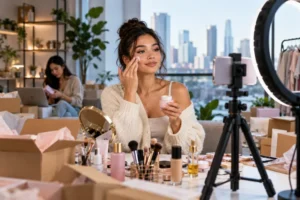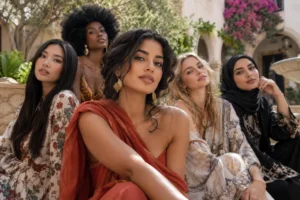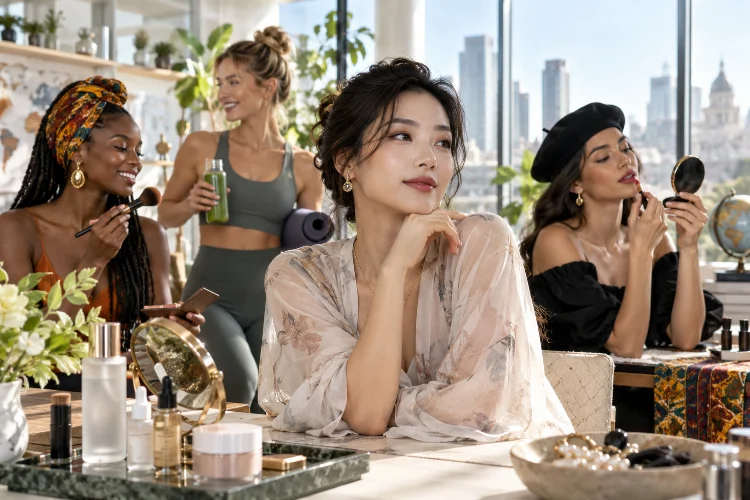
A woman in Jakarta can watch a Korean skincare routine in the morning, follow an American fitness creator at lunch, buy a French beauty product in the afternoon, and discover a Brazilian makeup trend before bed.
That level of cultural exchange would have been almost unimaginable a few generations ago.
Today, beauty trends travel across borders at extraordinary speed. Fashion brands, streaming platforms, celebrities, influencers, migration, tourism, and global cosmetic companies constantly introduce people to appearances that originated somewhere else.
This is why globalization transforms women’s beauty standards worldwide in such a complicated way.
On one hand, international media can make certain features – clear skin, slim bodies, youthful faces, or particular makeup styles – seem increasingly universal. On the other, local cultures rarely disappear completely.
Instead, beauty ideals mix.
Korean skincare can merge with Indonesian preferences, Western body trends can be adapted in Latin America, and traditional hairstyles can return through global social movements. Modern beauty is increasingly global, but it is also constantly being rewritten locally.
Beauty Standards Now Travel Faster Than Ever
Beauty ideals have crossed borders for centuries through trade, colonization, migration, art, and fashion.
What has changed is speed.
Television and magazines once introduced international celebrities to large audiences. Social media has accelerated that process dramatically because trends can now spread across continents within hours.
A makeup technique posted in Seoul can appear in tutorials from Bangkok, London, Los Angeles, and Jakarta almost immediately.
Research comparing women in the United States, Italy, England, and Australia found that media was the strongest reported source of pressure toward thinness and appearance ideals across all four countries.
Researchers suggested that increasingly globalized media exposure may help explain some of these similarities.
This does not mean everyone suddenly wants to look identical.
It does mean that local beauty cultures are now exposed to an unprecedented number of outside influences.
Social Media Creates a Global Beauty Feedback Loop
Platforms such as Instagram, TikTok, YouTube, and similar visual networks have changed who creates beauty trends.
Traditionally, fashion magazines, film studios, cosmetic brands, and celebrities controlled much of the conversation. Now ordinary users, influencers, dermatologists, makeup artists, and content creators participate as well.
That sounds more democratic, and sometimes it is.
The problem is that algorithms often reward highly polished, visually striking content. Filters, editing tools, professional lighting, cosmetic procedures, and carefully selected angles can make an unrealistic appearance seem normal.
A 2024 systematic review found that idealized and digitally altered social media images are associated with body dissatisfaction and greater interest in cosmetic procedures.
This creates a feedback loop.
Users see a popular look, imitate it, post their own version, and help make the same aesthetic even more visible.
The result is a global beauty environment that can feel strangely diverse and standardized at the same time.
K-Beauty Shows That Influence No Longer Flows Only From the West
For much of the modern era, discussions about globalization and beauty focused heavily on Western influence.
Hollywood, European fashion, and American advertising certainly shaped beauty ideals internationally. But influence now moves in multiple directions.
South Korea is one of the clearest examples.
K-pop, Korean dramas, skincare routines, cosmetic brands, and celebrity culture have made Korean beauty aesthetics highly influencial across Asia and beyond.
Glowing skin, elaborate skincare routines, gradient lip looks, and softer makeup styles have reached consumers far outside Korea.
A study of Indonesian skincare advertising found visible influence from the Korean Wave, including portrayals of beauty associated with white, flawless, and glowing skin.
This is an important change.
Globalization is not simply Westernization anymore. Japanese beauty, Korean skincare, Brazilian body aesthetics, Indian hair traditions, African beauty entrepreneurship, and Middle Eastern makeup cultures can all travel internationally.
The global beauty map has become much more multidirectional.
Local Cultures Adapt Global Trends Instead of Simply Copying Them
A common mistake is assuming globalization erases local beauty traditions.
Usually, the process is more complicated.
Consumers often take an international trend and reinterpret it according to local skin tones, religious expectations, climate, fashion, social class, or cultural preferences.
A Korean-inspired skincare routine in Indonesia, for example, may be adapted for tropical weather and local products. Western makeup techniques may be modified to suit different facial features or modest fashion styles.
Research among young Chinese women shows another example of this hybrid environment.
Participants described mainstream social-media beauty as involving thinness, curves, flawless skin, delicate makeup, and fashionable clothing – a combination of influences rather than one purely traditional standard.
This blending process is sometimes called cultural hybridization.
It explains why globalization rarely produces one universal beauty ideal.
Instead, it creates overlapping standards.
Skin Tone Reveals the Complicated Side of Global Beauty
Not every global beauty trend is harmless or new.
Preferences for lighter skin in parts of Asia, Africa, Latin America, and other regions are connected to complex histories involving class, colonialism, race, caste, colorism, and local social hierarchies.
Global advertising can reinforce these preferences.
Research examining skin-lightening practices in South Africa has argued that their popularity cannot be explained by Western media alone. Colonial history, apartheid, race politics, interpersonal expectations, and global beauty messaging all interact.
That complexity matters.
It would be too simple to claim that globalization created colorism. In many places, lighter-skin preferences existed long before contemporary social media.
However, international brands and celebrity imagery can amplify existing inequalities by repeatedly presenting certain skin tones as more desirable.
At the same time, global campaigns celebrating deeper skin tones and wider shade ranges have challenged those assumptions.
Globalization can spread a problematic standard and the resistance to that standard at the same time.
Cosmetic Procedures Are Becoming Part of Global Beauty Culture
Another major shift is the globalization of aesthetic medicine.
Botox, fillers, rhinoplasty, eyelid surgery, liposuction, breast procedures, and facial treatments are now marketed internationally. Medical tourism also allows people to travel specifically for cosmetic procedures.
The scale is significant.
According to the International Society of Aesthetic Plastic Surgery, more than 35 million surgical and non-surgical aesthetic procedures were performed by plastic surgeons worldwide in 2025. Women accounted for roughly 85% of both surgical and non-surgical procedures.
The types of procedures also reveal regional and global preferences.
Eyelid surgery became the most common surgical procedure worldwide in the 2025 ISAPS survey, while botulinum toxin remained the most common non-surgical treatment.
These numbers do not prove that the world has one beauty standard.
They show that changing appearance through medical technology has become increasingly normalized across very different societies.
Globalization Can Narrow Beauty Ideals
There is an uncomfortable contradiction within global beauty culture.
People have access to more faces, bodies, skin tones, hairstyles, and cultures than ever before. Yet the most visible online images can still become surprisingly repetitive.
Slim waists, clear skin, youthful faces, symmetrical features, defined cheekbones, large eyes, or particular body proportions can appear repeatedly across international feeds.
When these characteristics are enhanced using filters or cosmetic treatments, they can become difficult – or impossible – to achieve naturally.
The pressure is especially strong for young women.
Research involving 2,000 Indonesian girls and young women aged 15 to 19 described body dissatisfaction as a global concern and specifically examined internalization of appearance ideals and dissatisfaction with skin shade.
This demonstrates why media literacy matters.
The most visible appearance online is not necessarily the most common appearance in real life.
Popularity and normality are not the same thing.
Globalization Also Expands Beauty Diversity
The story is not entirely negative.
The same technologies that spread narrow beauty standars also allow people to challenge them.
Body-positive creators, disability advocates, older influencers, plus-size models, dark-skinned beauty creators, people with visible skin conditions, and communities celebrating natural hair can reach global audiences without depending entirely on traditional fashion institutions.
Research on body-positive content suggests that social media can support more inclusive approaches to body image when users are exposed to diverse bodies and messages that challenge narrow appearance ideals.
Natural hair movements offer another example.
Styles that were once marginalized in mainstream Western beauty media can now circulate internationally and become sources of cultural pride.
The expansion of foundation shade ranges is also partly connected to consumers publicly demanding better representation.
Globalization therefore increases both pressure and resistance.
The same phone that displays an unrealistic filtered face can also introduce someone to communities celebrating features they were previously encouraged to hide.
Beauty Is Becoming Global and Local at the Same Time
The future of beauty will probably not involve one worldwide ideal.
A more likely outcome is a collection of overlapping aesthetics.
Someone may follow Korean skincare, wear traditional African braids, enjoy American streetwear, prefer Japanese-inspired makeup, and still follow beauty traditions from their own community.
Identity becomes layered rather than replaced.
This is one reason companies increasingly localize international campaigns. A global beauty brand may sell the same product in dozens of countries while changing models, shade ranges, advertising language, and styling to fit different audiences.
Consumers are doing something similar themselves.
They combine international influences with local traditions and personal preferences.
That process creates more diversitiy, but it also makes beauty trends move faster. A feature that becomes fashionable globally today may be replaced by another within a few years.
Beauty has become less geographically isolated – and much more fluid.
Globalization has transformed women’s beauty standards by connecting cultures that once developed their appearance ideals more independently.
Social media, entertainment, migration, K-beauty, global advertising, and cosmetic medicine now allow trends to move rapidly between countries.
But globalization has not created one universal definition of a beautifull woman.
Instead, it has produced a complicated mix of shared trends, local traditions, commercial pressure, historical inequalities, and growing resistance to narrow ideals.
The most useful lesson is to view modern beauty critically rather than assuming every popular feature is natural or timeless.
Pay attention to where a trend comes from, how it changes when it crosses borders, and who benefits from promoting it. Doing so reveals that beauty is not simply personal taste – it is also a fascinating record of global cultural exchange.