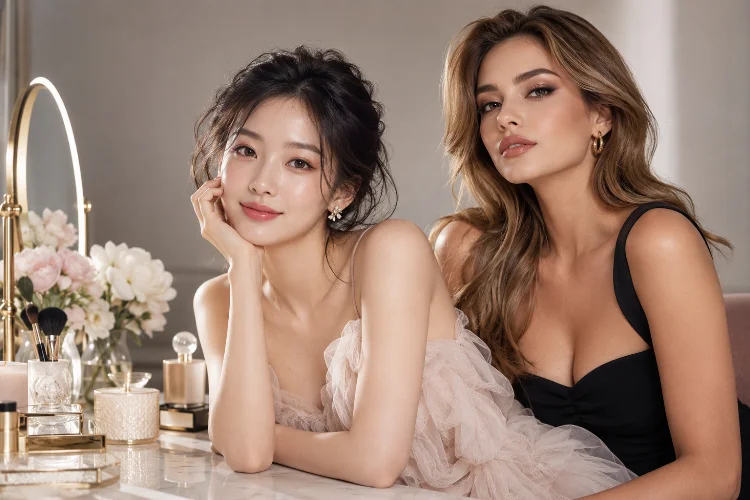
Beauty feels personal, but our idea of what looks attractive is shaped by much more than individual taste. Family expectations, celebrities, advertising, history, social class, fashion, and even climate can influence what people consider beautiful.
This becomes especially interesting when comparing Eastern and Western beauty cultures.
In many East Asian societies, beauty trends have historically placed strong emphasis on clear skin, youthful facial features, slender bodies, and carefully refined presentation.
Western ideals, particularly in Europe and North America, have often shifted between slim, athletic, curvy, and highly sculpted body types while placing considerable attention on individuality and sexual attractiveness.
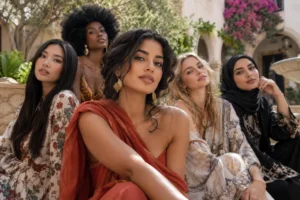
Still, understanding the differences between Eastern and Western beauty ideals requires caution. Neither “East” nor “West” represents one single culture. Japan, China, Korea, France, Italy, and the United States all have their own histories.
The real story is not about two completely opposite standards. It is about different cultural priorities that increasingly overlap in a globalized world.
Eastern Beauty Often Places More Attention on the Face
One commonly discussed difference involves where beauty attention is concentrated.
Research reviewing cross-cultural body image suggests that East and Southeast Asian beauty cultures can place particularly strong emphasis on facial appearance, including the eyes, nose, jawline, skin, and overall face shape.
Western beauty culture also cares deeply about the face, of course, but body shape has historically received especially intense attention in Western fashion and media.
In contemporary East Asian aesthetics, an oval or softly tapered face, smooth skin, larger-looking eyes, and balanced facial proportions frequently appear in popular beauty imagery.
Cosmetic practices reflect some of these interests. Double-eyelid procedures, jawline treatments, nose augmentation, and facial contouring have become visible parts of beauty culture in several Asian markets.
However, this should not automatically be interpreted as a desire to “look Western.” Research on aesthetic preferences suggests that many Asian consumers seek enhancement while retaining recognizable ethnic characteristics.
Body Shape Has Played a Larger Role in Many Western Ideals
Western beauty media has long placed significant emphasis on the female body.
The exact ideal has changed repeatedly.
The slim silhouettes celebrated by fashion magazines in some decades gave way to fitness-oriented bodies, while other periods emphasized curves, large breasts, defined waists, or prominent hips.
Modern Western beauty culture often combines several expectations at once: a woman may be encouraged to look slim but curvy, athletic but feminine, toned without appearing overly muscular, and youthful while still looking “natural.”
That creates a difficult standard because some desired features can contradict one another.
Cross-cultural research also shows that preferences for body proportions vary considerably between ethnic and cultural groups. There is no scientifically universal ideal waist, hip, breast, or facial ratio that reliably represents beauty everywhere.
This is why treating Western beauty standars as a universal benchmark can be misleading.
Skin Tone Reveals One of the Clearest Cultural Differences
Skin color provides another useful example.
In several East Asian cultures, lighter and clearer skin has historically been associated with beauty, status, refinement, and protection from outdoor labor. Contemporary beauty advertising continues to promote bright, even-looking complexions in many Asian markets.
Research on Chinese facial preferences, for instance, identifies fair and unblemished skin as an important feature within many contemporary beauty ideals.
In many Western societies, the relationship with skin tone has developed differently.
During earlier European history, pale skin also represented status. Yet tanning became fashionable during the 20th century, eventually becoming associated in some contexts with leisure, health, travel, and an outdoor lifestyle.
Recent cross-cultural research has found similar differences: East Asian participants showed stronger preferences for lighter skin tones, while Western participants in the study tended to favor darker complexions.
Of course, these trends are not universal.
Skin-lightening practices also occur outside Asia, including parts of Africa, the Caribbean, and other regions. The World Health Organization emphasizes that demand is influenced by a complicated combination of advertising, social expectations, and cultural beauty ideals.
Makeup Reflects Different Ideas About Femininity
Makeup techniques can reveal cultural priorities surprisingly well.
Many East Asian beauty styles emphasize youthful, soft-looking features. Makeup may aim for luminous skin, subtle blush, straighter or softly shaped eyebrows, enlarged-looking eyes, and relatively delicate lip colors.
Korean beauty trends provide an obvious example.
The popularity of “glass skin,” gradient lips, lightweight foundation, and carefully layered skincare helped make a fresh, youthful complextion internationally recognizable.
Western makeup traditions often emphasize stronger facial definition.
Contouring can create sharper cheekbones, bronzer adds warmth, mascara and eyeliner make the eyes more dramatic, and lip products may deliberately produce fuller-looking lips.
Yet these differences are becoming less clear.
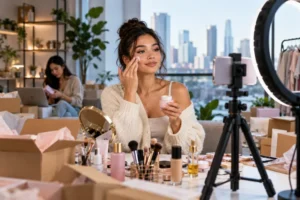
Western consumers now follow Korean skincare routines, while East Asian creators regularly experiment with European and American makeup styles. TikTok, Instagram, and YouTube have turned beauty techniques into global rather than purely regional trends.
Youthfulness Is Important in Both Cultures, but Expressed Differently
One major similarity between Eastern and Western ideals is the value placed on youth.
Both beauty cultures frequently associate youthful appearance with smooth skin, healthy hair, facial symmetry, and physical vitality.
The methods used to emphasize youth can differ.
East Asian skincare cultures often focus heavily on prevention, hydration, sun protection, brightening, and maintaining smooth skin from relatively young ages.
Western beauty industries have traditionally marketed many products around correcting visible signs of aging, although preventive skincare has become increasingly common there as well.
Research into Asian aesthetic preferences has noted especially strong interest in smooth, clear, youthful-looking skin.
Western markets, meanwhile, have developed huge industries around anti-aging creams, injectables, fillers, cosmetic procedures, fitness, and hair coloring.
Different routines can therefore pursue a remarkably similar goal: preserving visible youth.
Individuality and Conformity Shape Beauty Differently
Culture can also influence why people follow beauty standards.
Western societies are frequently described as more individualistic, meaning personal identity and self-expression receive greater cultural emphasis. Fashion and makeup are often presented as ways to “be yourself,” even when consumers are still following widely shared trends.
Several East Asian societies place greater emphasis on social harmony and awareness of how a person is perceived within a group.
This can make neatness, refinement, and fitting expected appearance norms particularly important.
However, this contrast should not be exaggerated.
Western fashion can be extremely conformist, while Japanese street fashion, Korean subcultures, Chinese beauty creators, and other Asian communities demonstrate enormous creativity and individuality.
The difference is better understood as a tendency rather than a rule.
Modern beauty culture contains both conformity and self-expression almost everywhere.
Social Media Is Making Eastern and Western Ideals Overlap
Perhaps the biggest change is that beauty cultures are no longer geographically isolated.
K-pop stars influence fashion in Europe and America. American celebrities influence makeup trends in Asia. Korean skincare products are sold globally, while Western luxury brands use Asian celebrities as international ambassadors.
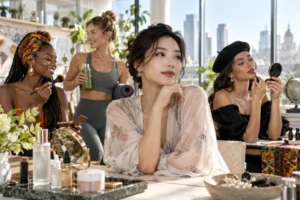
This exchange has created hybrid beauty standards.
A woman might follow Korean skincare, use American contouring techniques, admire French minimalist fashion, and purchase Japanese cosmetics without seeing any contradiction.
Researchers studying global body image have found that media influence now plays an important role across numerous Asian as well as Western societies.
Globalization therefore makes direct comparision increasingly difficult.
Eastern and Western ideals still have distinct historical roots, but the boundaries are becoming much less obvious.
Neither Culture Has One Universal Beauty Standard
One of the biggest mistakes in discussing beauty is assuming every person within a culture wants the same appearance.
China alone contains more than a billion people and enormous regional, generational, and socioeconomic diversity. The same applies when trying to describe “Western beauty” across Europe and North America.
Age matters. Social class matters. Ethnicity, religion, sexuality, geography, subculture, and personal preference matter too.
Research reviewing facial and body aesthetics repeatedly shows that attractiveness preferences vary between populations and that universal mathematical formulas for beauty perform poorly across different ethnic groups.
That is a useful reminder.
Cultural beauty standards can influence people strongly without determining what every indvidual finds attractive.
Global Beauty Is Becoming More Diverse – and More Complicated
Globalization has produced an interesting contradiction.
People now see more types of beauty than previous generations ever could. A teenager can instantly discover models, musicians, creators, hairstyles, clothing, and makeup traditions from dozens of countries.
At the same time, social-media algorithms can repeatedly promote very similar faces and bodies.
Filters can enlarge eyes, smooth skin, reshape noses, sharpen jaws, or alter body proportions. Cosmetic treatments can then reproduce some digitally popular features in real life.
The result is not simply Eastern beauty becoming Western or Western beauty becoming Eastern.
Instead, a new international beauty culture is emerging.
It borrows features from many regions while still being interpreted through local traditions.
That may be the most influencial change of all.
Understanding Eastern and Western beauty ideals reveals both meaningful cultural differences and surprising similarities.
East Asian beauty cultures often emphasize youthful facial features, clear skin, slenderness, and refined presentation, while many Western trends have historically placed stronger attention on body shape, tanning, definition, and individual expression.
Yet none of these preferences are fixed.
Migration, entertainment, global cosmetics, K-beauty, celebrity culture, and social media constantly move ideas between regions. As a result, modern beauty is becoming increasingly hybrid.
Rather than asking which culture has the “better” standard, look at how each ideal developed and why it became desirable.
Doing that makes beauty much more interesting – not as a universal rule, but as a reflection of history, culture, technology, and changing social values.