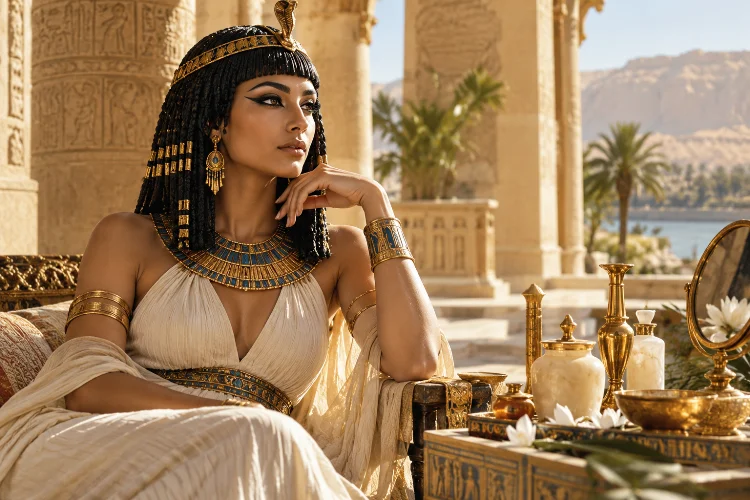
Beauty trends may seem like a product of Instagram, magazines, and celebrity culture, but ancient Egyptians were paying close attention to appearance thousands of years ago.
From carefully lined eyes to elaborate wigs, scented oils, jewelry, and finely woven clothing, personal presentation played a surprisingly important role in everyday and religious life.
What makes women’s beauty ideals in Ancient Egypt especially fascinating is that they were not completely fixed.
Although certain features – such as youthful appearance, neat grooming, and symmetrical presentation – remained popular for centuries, artistic styles and elite fashions evolved as Egyptian society changed.
Beauty was also about far more than attracting attention. Cleanliness could carry religious significance, cosmetics could offer practical protection, and a fashionable hairstyle might reveal social position. Even representations of queens were shaped by politics and divine symbolism.
Looking across several thousand years of Egyptian civilization reveals a beauty culture that was sophisticated, symbolic, and far more dynamic than the famous black eyeliner alone suggests.
Beauty in Ancient Egypt Was More Than Physical Appearance
Ancient Egyptian beauty was closely tied to cleanliness, order, status, and religious ideas. Both men and women used cosmetics, and grooming items appear frequently among surviving objects and burial goods.
This means beauty products were not automatically considered feminine luxuries. Kohl jars, mirrors, razors, tweezers, oils, and cosmetic containers could form part of a well-equipped personal grooming collection.
A New Kingdom kohl kit in the Metropolitan Museum, for example, was discovered together with a mirror, razor, whetstone, and tweezers.
Cleanliness also had spiritual associations. Preparing the body, wearing clean clothing, applying scented oils, and using eye makeup could be connected to ideas of purity and proper presentation before the gods.
For Egyptian women, therefore, looking attractive was often connected with appearing healthy, orderly, prosperous, and ritually prepared.
Early Beauty Ideals Focused on Youth and Order
Egyptian artistic conventions developed early and remained remarkably durable. Female figures were commonly represented with youthful bodies, smooth skin, narrow waists, and balanced proportions.
These images should not always be interpreted as realistic portraits of ordinary Egyptian women. Egyptian art frequently represented people according to cultural ideals rather than documenting exactly how they looked at a particular age.
Youthfulness was especially persistent. Even individuals who lived to an advanced age could be represented with youthful bodies. The coffin of Iineferty, for instance, depicts her as a slender figure despite evidence that she may have been at least 75 when she died.
This tells us something important about Egyptian beauty standars: art often showed how a person was meant to exist eternally rather than simply recording their everyday physical condition.
Beauty was connected to perfection, vitality, and renewal.
Kohl Turned the Eyes Into a Beauty Statement
Few elements of ancient Egyptian appearance are more recognizable than heavily outlined eyes.
Egyptians used several powdered minerals as eye cosmetics, generally described today as kohl. The Metropolitan Museum notes that these powders were stored in containers made from materials including wood, stone, faience, and glass and applied with narrow sticks.
During the Middle Kingdom, royal cosmetic equipment could become extremely luxurious.
A kohl jar belonging to Princess Sithathoryunet, dating to roughly 1887-1813 BCE, was made from obsidian with gold decoration. The materials clearly transformed a practical cosmetic object into a symbol of elite status.
Eye makeup enhanced the shape and symetry of the eyes, but its importance went beyond fashion. Cosmetics were also associated with personal care and protection.
That combination – beauty, health, religion, and status – helps explain why Egyptian cosmetcs remained important for centuries.
Hairstyles and Wigs Became Increasingly Elaborate
Hair was another major element of female beauty, and hairstyles changed noticeably across Egyptian history.
Women could wear their natural hair, arrange it in braids, or use wigs. Among wealthier Egyptians, wigs provided opportunities to create impressive styles that required significant time, materials, and craftsmanship.
By the New Kingdom, elite female hairstyles could become highly sophisticated. Funerary images from Dynasty 18 show women wearing full wigs combined with ornamental bands and jewelry. Later Ramesside examples continued this preference for elaborate hair arrangements.
One reason hairstyles are useful to archaeologists is that fashion changes can sometimes help date artworks.
A wooden figure of a young woman from Dynasty 18, for example, wears an elaborately curled wig with multiple braids, while other periods favored different arrangements.
Much like hairstyles today, Egyptian hair fashion was both personal decoration and a visual marker of time and social identity.
The New Kingdom Made Elite Fashion More Luxurious
Egypt’s New Kingdom, beginning around 1550 BCE, was a period of enormous political power and international contact. Elite fashion reflected some of that prosperity.
Clothing became increasingly elaborate in artistic representations, while wealthy individuals had access to jewelry, perfumes, sophisticated cosmetics, and decorative containers.
Fine linen could produce elegant garments that emphasized rather than completely concealed the shape of the body.
Jewelry also played a major role in creating the ideal appearance. Broad collars, earrings, bracelets, necklaces, and decorative hair ornaments could transform an otherwise simple outfit.
A New Kingdom female figurine in the Metropolitan Museum combines jewelry, an elaborite hairstyle, a narrow waist, and youthful physical features.
Interestingly, such figures were also associated with fertility and rebirth, demonstrating again that an attractive female form could carry religious meaning.
Beauty among elite women had become a carefully constructed combination of body, fabric, scent, cosmetics, hair, and valuable accessories.
Queens Show How Beauty and Political Power Intersected
Royal women reveal another side of Egyptian appearance because their images were shaped by political expectations.
Hatshepsut is the clearest example. After becoming pharaoh in the 15th century BCE, she could be represented in feminine clothing, but many official sculptures also presented her using the traditional visual language of a male Egyptian king.
The Metropolitan Museum explains that Egyptian rulers were traditionally depicted as youthful men in their physical prime regardless of their actual age or, in Hatshepsut’s case, sex.
Her royal image could therefore include a nemes headcloth, male body conventions, and even a false beard while inscriptions continued to acknowledge her feminine identity.
This was less about Hatshepsut trying to appear personally attractive and more about fitting an established image of legitimate kingship.
Her case demonstrates that ideals of appearance depended on context. A woman could embody conventional feminine beauty in one image and political authority in another.
Nefertiti and the Amarna Period Changed the Visual Rules
One of the most dramatic shifts happened during the reign of Akhenaten in the 14th century BCE.
Traditional Egyptian royal art had usually emphasized stable, idealized forms. Amarna-period artists experimented with something different. Royal figures could appear with elongated heads, narrow eyes, prominent stomachs, curved bodies, and more individualized facial characteristics.
Nefertiti became central to this new visual culture.
The Metropolitan Museum’s relief of Nefertiti shows her with a sharply angled profile, slanted eyes, distinctive chin, and towering royal headdress. She also appears participating prominently in religious rituals, reflecting her unusually powerful position at court.
Amarna art also depicted royal family members interacting with an intimacy uncommon in earlier official imagery. Research from the Met describes the period as a major departure from traditional representations, particularly in portrayals of royal women.
The famous Nefertiti image we recognize today therefore came from a brief but revolutionary artistic moment rather than representing a universal Egyptian ideal.
Beauty Was Connected to Eternal Youth and the Afterlife
Perhaps the biggest difference between modern beauty culture and the ancient Egyptian version is the importance of eternity.
Egyptians believed that death was followed by continued existence, so the body and personal identity required preparation. This helps explain why mirrors, cosmetics, jewelry, perfumes, clothing, and grooming equipment have been discovered in funerary settings.
Funerary masks could present deceased women with youthful faces, decorative wigs, jewelry, and flawless appearances. Iineferty’s mask, for example, presents her with a long braided wig, decorative bands, and a lotus blossom associated with rebirth.
Beauty was therefore almost ritualy timeless.
The goal was not merely to appear fashionable for other living people. An idealized appearance could symbolize health, renewal, prosperity, and the perfected version of a person who would continue into the next world.
The evolution of women’s beauty ideals in Ancient Egypt shows that appearance was never simply about vanity.
Cosmetics, hairstyles, clothing, body imagery, jewelry, and perfume reflected changing ideas about wealth, femininity, religion, social position, and political authority.
Some preferences remained remarkably stable, especially youthfulness, careful grooming, and balanced physical presentation.
Others changed significantly. New Kingdom luxury produced increasingly elaborate fashions, while the Amarna period briefly challenged centuries of artistic convention with more individualized representations of royal women.
Perhaps the most interesting lesson is that beauty was not separated from Egyptian culture – it was part of it.
Explore Egyptian museum collections and ancient artwork more closely, and familiar images of eyeliner and wigs begin to reveal a much richer story about identity, power, and eternal life.