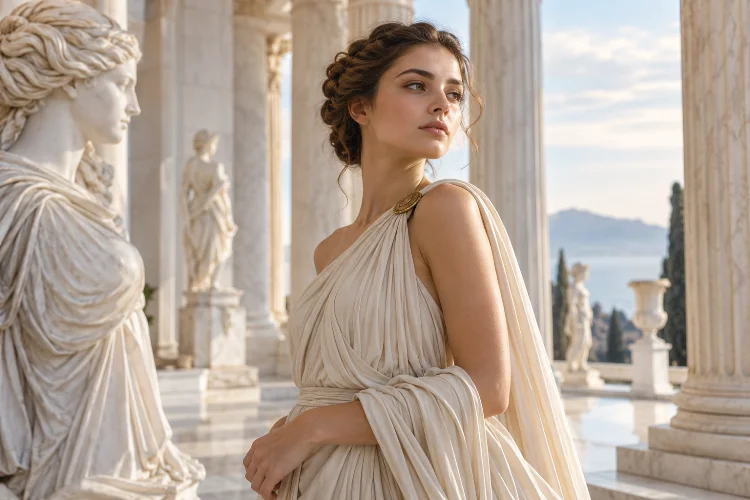
Walk through almost any major European art museum and you will eventually encounter a familiar-looking body: balanced proportions, smooth features, carefully arranged hair, controlled posture, and an appearance that seems natural while somehow being more perfect than real life.
Much of that visual language can be traced back to ancient Greece.
Classical Greek artists did not simply copy the human body exactly as they saw it. They observed anatomy and movement, but they also reorganized the body according to ideas about harmony, proportion, balance, youth, and ideal form.
Sculptors such as Polykleitos and Praxiteles developed images that became extraordinarily influential in the ancient Mediterranean. Roman artists copied them, Renaissance artists rediscovered them, and Neoclassical sculptors revived them centuries later.
Understanding how Classical Greek aesthetics shaped later beauty expectations therefore means following a cultural chain stretching across more than two thousand years.
Many supposedly “timeless” Western beauty ideals are actually historical ideas repeatedly revived and reinterpreted.
Greek Beauty Was Built Around Harmony and Proportion
One of the most influential Greek ideas was that beauty could result from a harmonious relationship between different parts of the body.
The sculptor Polykleitos explored this concept during the fifth century BCE.
His lost treatise, known as the Canon, apparently described a system in which individual body parts related proportionally to one another. His famous Doryphoros, or Spear-Bearer, visually demonstrated those principles.
This was not simply a quest to create a realistic man.
The figure combined observed anatomy with idealization. Muscles, limbs, posture, and proportions were organized into a balanced whole. Beauty became something that could theoretically be constructed through relationships between parts.
Later European artists found this concept extremely attractive.
The idea that an ideal body followed measurable proportions returned strongly during the Renaissance.
Leonardo da Vinci’s famous Vitruvian Man, although based directly on the Roman architect Vitruvius, belonged to this broader revival of classical thinking about the mathematically ordered human body.
The legacy remains visible whenever modern culture talks about ideal facial proportions, balanced features, or bodily symetry.
Contrapposto Changed What an Attractive Body Looked Like
Greek artists also transformed the way beautiful bodies were posed.
Earlier Archaic statues often appeared relatively stiff and frontal. Classical sculptors increasingly showed figures shifting their weight naturally onto one leg, creating a subtle relationship between the hips, shoulders, and spine.
This posture became known as contrapposto.
In works such as the Doryphoros, the body seems relaxed but controlled. One leg carries the weight while the other is free, creating a sense of potential movement. The result feels more lifelike than a completely symmetrical pose.
That innovation influenced Western art for centuries.
Roman sculptors adopted it. Renaissance artists revived it, and Neoclassical artists used it again during the 18th and 19th centuries.
Even modern fashion photography often relies on similar principles when models shift their hips or distribute their weight unevenly to create a more graceful silhouette.
Classical beauty was therefore not just about measurements. It was also about how the body occupied space.
Aphrodite Created a Lasting Model of Feminine Beauty
The development of the female nude represents one of the most important chapters in the history of Greek beauty.
For centuries, major Greek sculptures generally showed respectable female figures and goddesses clothed. That changed dramatically in the fourth century BCE when Praxiteles created the Aphrodite of Knidos.
Although the original statue has been lost, numerous later copies preserve its general design. Aphrodite appeared nude, apparently preparing for or finishing a bath, with one hand positioned modestly across her body. The sculpture became famous throughout antiquity.
Her body was idealized rather than anatomically exaggerated. The figure combined soft proportions, graceful posture, youthfulness, and controlled sensuality.
The importance of this sculpture is difficult to overstate.
Later Hellenistic and Roman artists created countless variations on the nude Aphrodite. The visual formula eventually influenced Renaissance representations of Venus and helped establish the female nude as one of the central subjects of Western art.
From Botticelli’s Venus to later academic painting, echoes of Praxiteles remained surprisingly persistent.
Roman Copies Carried Greek Ideals Into Later Europe
Many famous Greek sculptures would have disappeared almost completely if Roman collectors and artists had not admired them.
Roman elites developed a strong taste for Greek art. Workshops produced marble versions of celebrated Greek bronzes, including works associated with Polykleitos and Praxiteles.
This copying process created a cultural bridge.
When Renaissance artists began studying ancient sculpture intensively, many of the objects available to them were actually Roman copies or adaptations of Greek originals. Europeans therefore inherited Classical Greek aesthetics partly through Roman interpretation.
The same process affected beauty expectations.
Smooth bodies, youthful faces, controlled expressions, carefully structured proportions, and graceful poses came to represent an idealized classical appearance.
These features were not exact descriptions of ordinary ancient Greeks. They were artistic constructions.
Yet because later generations viewed classical sculpture as authoritative, idealized ancient bodies gradually became reference points against which newer bodies were imagined and judged.
The Renaissance Revived Classical Ideas of the Ideal Body
Classical aesthetics received one of their most important revivals in Italy between roughly 1400 and 1600.
Renaissance artists, intellectuals, and patrons actively studied Greek and Roman culture. Sculptures, ancient texts, mythology, and surviving Roman monuments offered models that seemed to represent a sophisticated understanding of the human body.
Artists such as Michelangelo studied antique statues closely.
Renaissance painters also returned to classical mythology, allowing Venus, Apollo, and other ancient figures to become vehicles for exploring beauty, nudity, sensuality, and idealized anatomy.
Female beauty was affected particularly strongly through representations of Venus.
Botticelli’s Birth of Venus, Titian’s reclining Venuses, and countless later works did not simply reproduce ancient statues. They adapted classical ideas to contemporary European tastes.
Bodies became softer or fuller. Hairstyles changed. Facial features reflected local preferences.
The important point is that classical beauty was not copied exactly – it was constantly reinterpretated.
That flexibility explains why ancient Greek aesthetics remained useful for so long.
Neoclassicism Turned Ancient Beauty Into an Academic Standard
Another major revival arrived during the 18th and 19th centuries.
Archaeological discoveries in Greece and Italy increased European enthusiasm for the ancient world. Neoclassical painters and sculptors deliberately adopted poses, materials, clothing, and themes associated with antiquity.
American sculptor Hiram Powers, for example, used classical visual traditions in The Greek Slave, first modeled in the 1840s. The figure’s contrapposto stance and composition drew on ancient statues such as the Medici Venus.
This period helped turn Classical art into an institutional standard.
European academies taught students to draw antique casts. Artists studied idealized Greek and Roman bodies as models of good anatomy and proportion.
That educational system had consequences beyond art.
The classical body increasingly became associated with ideas such as refinement, civilization, intellectual sophistication, and physical perfection.
Beauty expectations were no longer simply being inherited through artworks. They were being formally taught.
The White Marble Ideal Was Largely a Later Misunderstanding
One of the most important corrections to traditional ideas about Greek beauty concerns color.
Today, people often picture Classical Greece as a world of perfectly white marble statues. That image became highly influential in European aesthetics, especially during the Renaissance and Neoclassical eras.
But ancient sculpture was often colorful.
Scientific research has identified traces of pigments and decorative surface treatments on numerous Greek and Roman objects. The Metropolitan Museum’s Chroma project has helped demonstrate how brightly painted ancient sculpture could originally have appeared.
Over centuries, much of that color disappeared.
Later Europeans encountered weathered white marble and began treating its monochrome appearance as an intentional Classical aesthetic. White marble gradually became connected with purity, refinement, simplicity, and ideal beauty.
That means one of the most influential later interpretations of Greek aesthetics was based partly on what had been lost.
The ancient world was much more colourfull than generations of European artists imagined.
Classical Ideals Still Appear in Modern Beauty Culture
Ancient Greek influence did not disappear when Neoclassicism declined.
Modern culture still uses language remarkably similar to classical aesthetics. Faces are praised as balanced or proportional.
Athletic bodies are valued for controlled musculature. Fashion models are posed according to principles of visual balance, while cosmetic analysis sometimes tries to reduce attractiveness to measurements.
However, claims about a single mathematical formula for beauty should be treated cautiously.
Classical artists certainly cared about proportion, but modern claims that every beautiful Greek statue followed one universal “golden ratio” often simplify a much more complicated artistic tradition.
Polykleitos was concerned with relationships between body parts, but the precise system described in his lost Canon remains uncertain.
There is another limitation worth remembering.
The beauty ideals preserved in famous Classical art were highly selective. They emphasized gods, athletes, heroes, elite subjects, and idealized youth rather than representing the enormous diversity of real ancient populations.
What later societies inherited was therefore an artistic ideal – not a documentary photograph of Greek life.
Classical Greek aesthetics shaped later beauty expectations because Greek artists created an unusually influential visual language for representing the ideal human body.
Harmony, proportion, youthful anatomy, graceful movement, contrapposto, and idealized figures such as Aphrodite became models that survived through Roman copies and were repeatedly revived.
The Renaissance adapted them, Neoclassical artists institutionalized them, and traces of the same concepts remain visible in modern discussions of facial balance, body proportion, and physical perfection.
Yet history also offers an important warning. Later cultures often changed Greek ideals while claiming to preserve them, as the famous misconception of pure white sculpture demonstrates.
Explore Classical artworks alongside their Renaissance and Neoclassical descendants, and beauty starts to look less timeless. It becomes a fascinating chain of cultural borrowing, reinvention, and changing expectations.