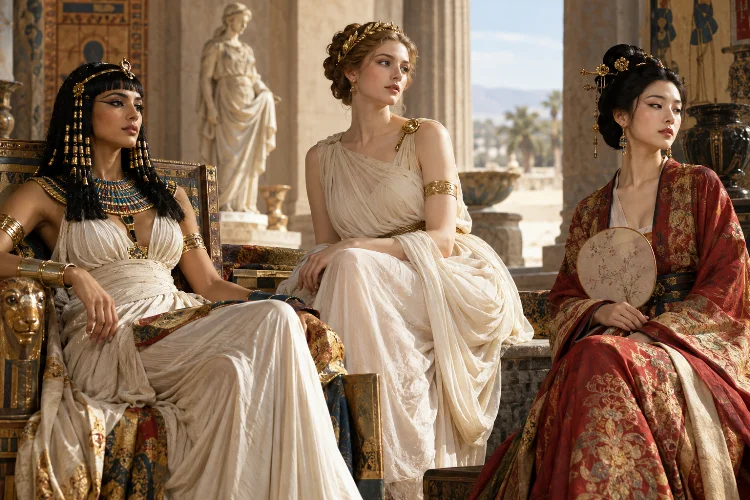
Beauty standards may feel like a modern obsession, fueled by social media, fashion magazines, celebrities, and advertising. But people were debating, displaying, and reshaping ideas of attractiveness thousands of years before the first beauty influencer appeared.
What makes ancient beauty especially interesting is that there was never a single definition of the “perfect woman.” Ancient civilizations defined female beauty according to their own environment, religion, social hierarchy, artistic traditions, and ideas about health or fertility.
Pale skin could signal privilege in one society, while elaborate jewelry, rounded body shapes, carefully styled hair, or symmetrical proportions carried greater importance elsewhere.
Even more importantly, ancient beauty standars were rarely about physical appearance alone. Looking beautiful could communicate wealth, respectability, divine favor, fertility, youth, or membership in the elite.
By comparing Egypt, Mesopotamia, Greece, Rome, India, China, and the Maya world, we can see that beauty has always been cultural rather than universal.
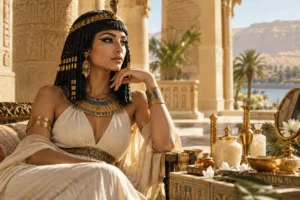
Ancient Egypt: Beauty, Cleanliness, and Divine Protection
Ancient Egyptians are probably among the best-known historical users of cosmetics.
Archaeological evidence shows that cosmetics were used by both women and men, with kohl being especially important. Containers found in elite burials show that cosmetics could also be luxury possessions.
Dark eye makeup was not simply decorative. Kohl emphasized the eyes dramatically, while oils and ointments helped protect skin in Egypt’s dry climate. Personal grooming therefore sat somewhere between beauty, hygiene, status, and practical skincare.
For elite women, smooth skin, carefully arranged hair or wigs, jewelry, perfume, and finely made clothing could communicate refinement.
Egyptian artistic representations often presented women as youthful and carefully composed rather than documenting every individual physical detail.
Beauty could even have a spiritual dimension. Cosmetics and grooming objects were placed in tombs because personal appearance remained significant in the afterlife. In other words, looking good was not necessarily supposed to end at death.
Mesopotamia: Jewelry Made Beauty Visible
In ancient Mesopotamia, physical appearance was closely connected to clothing and valuable ornamentation. The spectacular discoveries from the Royal Cemetery at Ur provide some of the clearest examples.
Women and girls buried there were adorned with jewelry made from gold, lapis lazuli, and carnelian. These were expensive materials, some obtained through long-distance trade networks, making personal decoration an obvious display of status and wealth.
Beauty, then, was not defined by facial features alone. A woman’s appearance could be transformed by earrings, necklaces, headdresses, clothing, and carefully arranged hair.
Jewelry also carried meanings beyond decoration. In Mesopotamian mythology, jewelry could symbolize divine authority and power.
The goddess Inanna-Ishtar, for example, loses aspects of her power while being stripped of her ornaments during her descent into the underworld.
This reveals something important about ancient beauty: adornment could communicate social and spiritual identity just as strongly as physical attractiveness.
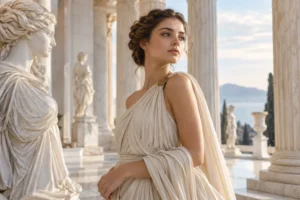
Ancient Greece: Youth, Proportion, and Idealized Beauty
Greek artists famously explored the idea of the ideal human body. Rather than simply reproducing ordinary people exactly as they appeared, many sculptures presented bodies according to highly idealized standards.
Archaic Greek statues known as korai represented young women wearing elaborate garments and accessories.
These figures emphasized youthfulness, order, dignity, and idealized appearance. Among aristocratic Greeks, physical beauty could even be associated with moral excellence.
The Greek fascination with proportion also shaped artistic ideas about attractiveness. Balance and symetry became important principles in Greek visual culture, although surviving discussions and sculptures focus more heavily on male bodies than female ones.
For women, beauty was often presented through youth, clear skin, graceful posture, clothing, hair, and harmonious features.
Greek standards were therefore not simply about being naturally attractive. Beauty became an ideal that art could refine beyond everyday reality.
Ancient Rome: Pale Skin and Elaborate Hairstyles
Romans absorbed many Greek aesthetic traditions, but they developed beauty fashions of their own.
Among elite Roman women, pale skin could indicate social privilege because it suggested that someone did not spend much of the day performing outdoor labor.
Archaeological and scientific evidence has even revealed Roman cosmetic creams designed partly to lighten the appearance of skin.
Darkened eyes and pronounced eyebrows were also fashionable at various times. Yet one of the most visible indicators of status was hair.
Roman hairstyles changed dramatically across generations. Wealthy women could wear carefully curled arrangements that required considerable skill, and during some imperial periods extremely elaborite hairstyles became fashionable.
Hairpieces could help achieve styles impossible with natural hair alone.
These trends demonstrate something surprisingly modern: Roman beauty standards could change quickly. A hairstyle that communicated elegance during one generation might look outdated during the next.
Beauty was already participating in a fashion cycle nearly two thousand years ago.
Ancient India: Beauty as Fertility and Prosperity
Ancient Indian art approached female beauty differently from the highly mathematical visual ideals associated with Greece.
Rather than focusing only on realistic anatomy, Indian artists frequently created stylized bodies carrying symbolic meaning. Female figures might feature narrow waists, broad hips, rounded breasts, graceful limbs, and large expressive eyes.
The Metropolitan Museum of Art notes that Indian sculptors often worked toward idealized forms rather than direct imitation of individual models.
One famous example is the Didarganj Yakshi, traditionally dated to around the third century BCE. The monumental female figure has wide hips and full breasts and is associated with ideas of fertility and prosperity.
This matters because ancient Indian female beauty could represent much more than sexual attractiveness. A beautiful female body might communicate abundance, fertility, nature, auspiciousness, or divine energy.
The idealized woman could therefore serve as both an aesthetic figure and a powerful cultural symbol.
China: Beauty Standards Changed With Dynasties
Chinese ideas of female beauty changed significantly over centuries rather than following one permanent formula.
Female figures from the Han dynasty, which ruled from 206 BCE to 220 CE, show how clothing, posture, hairstyles, and painted decoration contributed to representations of elite women.
Tomb figures also reveal how carefully presented attendants and court women became part of funerary culture.
Later Chinese history demonstrates even more clearly how quickly beauty ideals could change. During earlier periods, slenderness and grace were admired, while by parts of the Tang dynasty a fuller figure became fashionable among elite women.
The Metropolitan Museum’s research on Tang figurines describes this shift toward fuller-bodied court ladies during the eighth century.
Fashionable complextion, clothing, hairstyles, makeup, and body shape were therefore influenced by dynasty, social class, and court culture.
Chinese history reminds us that even within one civilization, there was never just one timeless definition of female beauty.
The Maya: Beauty, Jade, and Deliberate Body Modification
Ancient Maya aesthetics offer an especially useful reminder that modern Western beauty standards should not be projected backward onto every civilization.
Elite Maya people transformed appearance through jewelry and deliberate modifications of the body.
Jade was especially prestigious. Royal women could be depicted wearing jade or greenstone bracelets, ear ornaments, necklaces, elaborate clothing, and distinctive hairstyles.
Dental modification was another form of aesthetic expression. Some upper-class Maya individuals had teeth reshaped or drilled so gemstones could be inserted. Such modifications could beautify the wearer while also displaying social status.
Personal decoration therefore connected attractiveness with rank, religious symbolism, and cultural identity.
What might appear unusual from a modern perspective made perfect sense within Maya society. That is exactly why historical beauty standards are so revealing: they expose assumptions that people inside a culture may rarely question.
Why Ancient Female Beauty Was Never Universal
Looking across these civilizations, a clear pattern emerges. There has never been a universal female body, face, hairstyle, or skin tone that every society considered ideal.
Egyptians emphasized cosmetics and grooming. Mesopotamian elites displayed valuable jewelry. Greeks celebrated youth and harmonious proportions.
Romans followed changing cosmetics and hairstyles. Indian art connected feminine beauty with fertility and abundance, while Chinese preferences shifted dramatically across dynasties. Maya elites used precious ornaments and permanent body modification.
These differences were shaped by much more than personal taste. Climate, religion, class structure, trade, politics, artistic conventions, and access to luxury goods all influenced what societies considered attractive.
Beauty was essentially a cultural language.
Ancient civilizations defined female beauty in remarkably different ways, yet they shared one important habit: appearance was rarely meaningless.
A hairstyle could reveal status. Jewelry could represent divine authority. Cosmetics could communicate refinement.
Body shape could symbolize fertility, while skin tone might indicate whether someone belonged to the working population or privileged elite.
Studying these traditions also challenges the idea that today’s beauty standards are natural or permanent. History shows that ideals constantly change, sometimes dramatically within only a few generations.
The next time a modern beauty trend feels universal, remember the women of Egypt, Greece, Rome, India, China, Mesopotamia, and the Maya world. What societies call “beautiful” often tells us as much about the society as it does about the person being admired.
Explore more ancient art and archaeology, and you may discover that the history of beauty is really a history of culture itself.