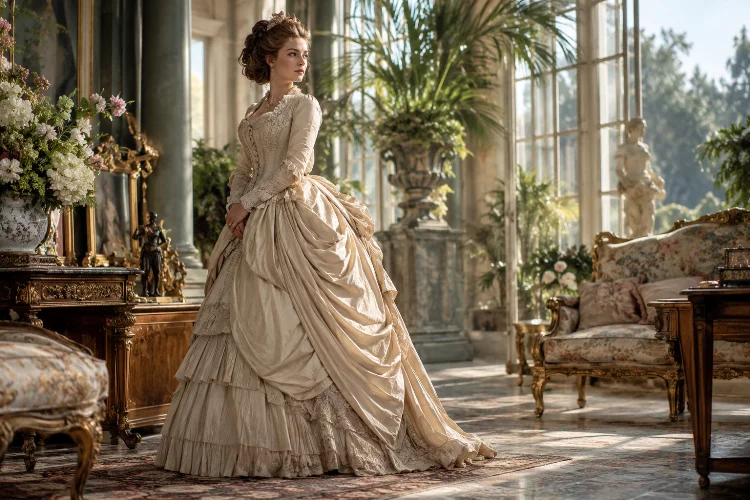
When people picture Victorian women, they often imagine tiny waists, enormous skirts, pale faces, elaborate hairstyles, and layers of fabric that seem almost impossible to move in.
That image is partly accurate, but Victorian beauty was far more complicated than the popular stereotype suggests.
The Victorian era, which lasted from Queen Victoria’s accession in 1837 until her death in 1901, covered more than six decades of rapid social and technological change.
Fashion changed repeatedly during that time. Bell-shaped skirts became enormous crinolines, volume later shifted toward the back through bustles, and by the 1890s some women were demanding clothing that allowed greater freedom of movement.
Understanding Victorian beauty ideals through historical fashion therefore means looking at how clothing physically constructed the fashionable body.
Beauty was not simply about natural appearance. It was shaped through corsetry, textiles, posture, hairstyles, complexion, accessories, and expectations about what a respectable woman should look like.
The Victorian Ideal Was Built Around the Silhouette
Victorian fashion did not follow one permanent body ideal. The fashionable female silhouette changed dramatically from the 1830s to the end of the century.
During the early Victorian period, dresses typically featured fitted bodices, narrow waists, and increasingly wide skirts.
The V&A notes that corsets helped round the bust, control the waist and stomach, and create a smooth foundation underneath clothing. Layers of petticoats then expanded the lower half of the body.
The result was an exaggerated contrast between a relatively small waist and a larger skirt.
This contrast mattered almost as much as the woman’s actual measurements. Historical clothing could create the illusion of a much narrower waist simply by widening the shoulders, sleeves, hips, or skirt.
Victorian beauty was therefore partly architectural. The fashionable silhoutte was built through fabric, boning, padding, and carefully engineered underwear rather than relying on the natural body alone.
Corsets Shaped the Body, but the Reality Was More Complex
No garment is more strongly associated with Victorian beauty than the corset.
Corsets were constructed using strong fabric, busks, cords, and flexible boning. During different periods they supported the bust, narrowed the waist, shaped the stomach, or controlled the hips depending on the fashionable form of the moment.
Technological developments also made corsets easier to mass-produce during the 19th century.
Popular culture often suggests that every Victorian woman was constantly squeezed into an impossibly tiny waist. Historical evidence is more nuanced.
Extreme tight-lacing certainly existed and attracted criticism, but museum collections suggest that sensational examples should not automatically be treated as normal everyday practice.
The V&A specifically notes that some of the most extreme corsets and bustles became the focus of contemporary criticism even though ordinary garments were often less dramatic.
The goal for many fashionable women was visual proportion rather than simply making the waist as small as physically possible.
Corsets helped produce that proportion, turning the dressed body into a carefully controlled shape.
Crinolines Made Small Waists Look Even Smaller
By the 1850s, fashionable skirts had grown so wide that wearing enough traditional petticoats to support them became heavy and uncomfortable.
The solution arrived in the form of the cage crinoline.
Introduced during the 1850s, steel-hooped crinolines created enormous skirt volume while being considerably lighter than multiple layers of stiff petticoats.
Sewing machines also helped make them more affordable, allowing the fashion to spread beyond the very wealthiest women.
The crinoline transformed female proportions.
Because the skirt expanded dramatically outward from the waist, the waist appeared smaller by comparison. In other words, Victorian fashion could create an hourglass impression through optical contrast instead of extreme body modification alone.
At the height of the trend, skirts became so large that satirical magazines mocked what was sometimes called “crinoline mania.”
There were practical problems too. Large skirts made narrow spaces difficult to navigate, and flammable fabrics worn around open fires created genuine hazards. Yet the style remained enormously popular because it delivered the fashionable shape of the period.
The Bustle Shifted Beauty Toward the Back of the Body
Victorian fashion changed again during the late 1860s.
Instead of creating equal volume around the entire lower body, designers gradually moved fullness toward the back. The crinoline became narrower, eventually giving way to crinolettes and then bustles.
During the 1870s, skirts could be relatively narrow at the front while fabric, pleats, decoration, and supporting structures projected behind the wearer.
The bustle became even more exaggerated when it returned strongly during the 1880s. Some designs used metal frameworks, while others relied on horsehair, padded cushions, or other structures. Different sizes were even available for different activities.
This demonstrates how quickly definitions of an attractive body could change.
A woman who looked perfectly fashionable in a huge circular crinoline in 1860 might appear noticeably outdated in the narrow-fronted bustle dresses of the 1870s.
Fashion did not simply follow the body. It repeatedly redesigned it.
Pale Complexions Suggested Refinement and Indoor Life
Clothing was only one component of Victorian beauty.
A clear, pale complexion was also widely associated with femininity and refinement, particularly among wealthier women. Like similar ideals in earlier European history, fair skin could imply that a woman did not perform prolonged agricultural or outdoor labor.
By the late 19th century, commercial beauty products increasingly promised to improve complexions.
A surviving advertisement held by the Wellcome Collection, dating to around 1900, promoted skin cream and soap as treatments for freckles, tanning, sunburn, blackheads, and blemishes.
It shows how appearance had become increasingly connected with a growing consumer beauty market.
The fashionable effect was often supposed to appear delicte and natural rather than dramatically painted.
That distinction is important. Victorian ideals frequently connected respectable femininity with the appearance of modesty. Looking carefully groomed was desirable, but visibly excessive artificiality could attract social criticism depending on the setting and decade.
Beauty therefore involved making considerable effort look almost effortless.
Dresses Communicated Respectability as Much as Attractiveness
Victorian female beauty cannot be separated from social expectations about respectable behavior.
Day dresses often covered much more of the body than evening clothing. High necklines, long sleeves, gloves, hats, and carefully chosen accesories could communicate modesty and social position.
Evening dresses might reveal the shoulders and upper chest, but that exposure was acceptable within particular formal contexts. Fashion was governed by rules about when, where, and by whom certain garments should be worn.
Queen Victoria herself influenced fashion during the earlier decades of her reign. The Metropolitan Museum of Art describes fashionable 1840s dress as featuring fitted corseted bodices and wide skirts, with Victoria’s youth and reputation for modesty helping shape contemporary styles.
The ideal woman was therefore expected to appear attractive without seeming socially inappropriate.
Clothing communicated not only wealth but also repectability, self-control, marital position, age, and understanding of social etiquette.
A beautiful dress was essentially a social message.
Industrialization Turned Fashion Into a Faster-Moving Beauty System
Victorian beauty standards also changed because fashion itself became easier to manufacture and distribute.
Sewing machines accelerated clothing production. Synthetic dyes introduced brighter colors. Mass-produced steel crinolines and manufactured corsets brought fashionable silhouettes within reach of larger sections of the expanding middle class.
Photography added another influence.
Carte-de-visite portraits allowed fashionable appearances to circulate visually, while printed fashion plates showed readers new dresses, hairstyles, and silhouettes. Luxury dressmaking also became increasingly organized around recognizable designers.
Charles Frederick Worth, one of the most influential designers of the late 19th century, helped establish practices associated with modern haute couture. The V&A credits him with transforming the way designs were presented to fashionable clients.
Beauty was becoming increasingly commercial.
Women no longer encountered fashionable ideals only at court or aristocratic gatherings. Images, advertisements, shops, manufacturers, photographers, and magazines all participated in spreading desirable appearances.
In many ways, Victorian society was developing an early version of the modern fashion-and-beauty industry.
The 1890s Began Challenging the Restrictive Ideal
By the final decade of Queen Victoria’s reign, the fashionable female silhouette began changing again.
Large bustles disappeared. Skirts became simpler and increasingly followed an A-line shape. Although corsets remained important, some reformers advocated clothing designed around health, comfort, and physical freedom.
These developments were connected with the growing idea of the “New Woman.”
More women were participating in education, public life, employment, cycling, sports, and campaigns for expanded rights. Extremely restrictive clothing could become inconvenient for these activities.
The Dress Reform Movement challenged conventional fashion by promoting alternatives to tight corsetry and heavy skirts. Some women experimented with divided skirts, looser garments, and more practical designs.
Mainstream fashion did not suddenly become completely comfortable or liberated. Corsets remained common, and the waist was still strongly emphasized during the 1890s.
But something fundamental was changing.
Female beauty was beginning to include mobility, activity, and independence alongside the older ideals of delicacy and decorative refinement.
Victorian beauty ideals were never defined by a single dress, waist measurement, or hairstyle.
During more than sixty years, fashionable women moved through fitted early Victorian gowns, enormous crinolines, dramatic bustles, tightly controlled corseted shapes, and eventually the more practical fashions associated with the New Woman.
Historical fashion shows that the Victorian body was often constructed rather than simply displayed. Corsets shaped the torso, skirts altered proportions, bustles changed the profile, while complexion, accessories, and etiquette communicated class and femininity.
These changing styles also reveal something surprisingly modern: beauty standards respond to technology, media, money, and social change.
Explore surviving Victorian garments in museum collections, and fashion becomes more than decoration. It becomes a visual record of how society expected women to look, move, and behave.