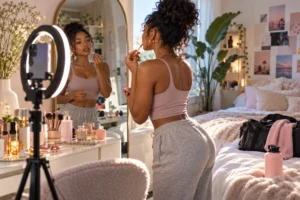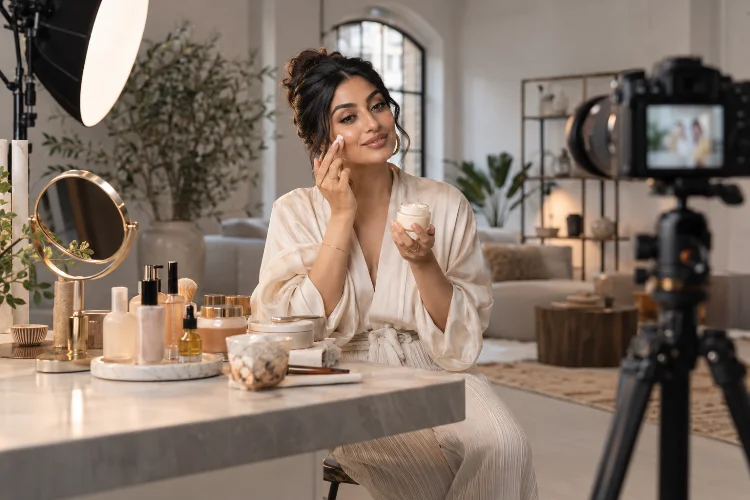
A beauty influencer casually applies foundation while talking about her morning routine. A fitness creator recommends leggings while showing a carefully sculpted body. Another creator shares a “natural” skincare routine while promoting three sponsored products.
None of these posts necessarily feels like traditional advertising. That is precisely what makes influencer marketing so powerful.
Instead of separating advertisements from entertainment, influencers often mix products with personal stories, lifestyles, appearance advice, and everyday routines.
Followers may see the same creator repeatedly, learn about her relationships, watch her transformation videos, and eventually feel as if they know her.
Understanding how influencer marketing shapes women’s perceptions of attractiveness therefore requires looking beyond whether an advertisement successfully sells lipstick or skincare.
Influencers can also provide visual reference points for what attractive skin, bodies, hair, clothing, and lifestyles supposedly look like.
Research suggests that upward comparison with influencers can be associated with lower body appreciation, while repeated exposure to idealized influencer content may affect body dissatisfaction and self-objectification.
Influencer Marketing Makes Advertising Feel Like Everyday Life
Traditional advertisements are usually easy to recognize.
You see a model holding perfume in a magazine and immediately understand that someone is trying to sell something. Influencer marketing often feels much less formal.
A creator might discuss her skin problems before introducing a serum, show a morning routine containing sponsored products, or recommend a hair treatment during an otherwise personal video.
The commercial message becomes part of everyday life.
This matters because influencers are not only presenting products. They frequently present the appearance that supposedly results from using those products.
The glowing skin becomes evidence for the serum. The styled hair becomes proof of the treatment. The toned body becomes part of the marketing environment around fitness clothing or supplements.
Advertising therefore sells both an object and an imagined version of the consumer.
Repeated Exposure Can Turn Influencer Looks Into Beauty Benchmarks
Seeing one unusually polished person rarely changes an entire beauty standard.
Seeing similar appearances every day can.
Influencers often work within highly visual platforms where certain aesthetics are repeatedly rewarded. Smooth skin, defined facial features, slim or athletic bodies, fashionable outfits, and professionally styled hair may appear again and again.
Research involving 5,060 women found associations between following nutrition and fitness influencers, social-media use, body dissatisfaction, and eating-disorder symptoms, although the study was observational and cannot establish simple cause and effect.
The larger issue is visiblity.
When a narrow range of appearances dominates a feed, those features can begin to look more common than they actually are.
A highly curated body stops looking exceptional and starts becoming a reference point.
Parasocial Relationships Make Influencers More Persuasive
One major difference between influencers and traditional models is the relationship followers can develop with them.
Psychologists call these one-sided connections parasocial relationships.
Followers may know an influencer’s favorite products, daily routine, personality, family stories, and opinions even though the creator does not personally know most followers.
Research on beauty and fashion influencers has found that repeated interaction and the perceived value of influencer content are connected with parasocial relationships.
A 2026 study involving 407 Indonesian beauty-influencer followers also found that expertise and trustworthiness were positively associated with parasocial relationships, which in turn were linked with purchase intentions.
This matters for attractiveness because advice can feel more powerful when it comes from someone who seems familiar.
A recommendation from a distant advertisement says, “Buy this product.”
A trusted influencer can feel more like, “This works for me, and maybe it can help you become more like the version of yourself you want to be.”
Social Comparison Can Turn Inspiration Into Self-Evaluation
Influencer content often begins as entertainment or inspiration.
A follower may enjoy someone’s makeup, clothes, or fitness routine without feeling threatened by it.
Problems can emerge when inspiration becomes constant upward comparision.
One study of young women found that browsing Instagram was associated with lower body appreciation specifically through upward comparison with influencers rather than close or distant peers.
Experimental research has also found that comparing one’s body with idealized Instagram models can increase appearance and weight dissatisfaction, particularly among women with higher appearance perfectionism.
The comparison is rarely equal.
A follower sees herself under ordinary lighting, during normal fluctuations in weight, skin, energy, and mood. The influencer may be presenting the best image selected from dozens of attempts.
Yet the brain can still place both appearances on the same scale.
Influencers Do Not Just Sell Products – They Sell Outcomes
Beauty marketing works especially well when products are connected to a visible transformation.
A lipstick is not simply pigment. It promises fuller-looking lips.
A serum becomes glowing skin. Gym clothing becomes an athletic identity. Hair products become volume, smoothness, or length.
Influencers make those outcomes easier to imagine because the result appears directly on a person followers recognize.
Recent marketing research shows that influencer attractiveness can affect persuasion through perceived expertise, credibility, and aesthetic appeal, although the strength of these effects depends partly on the product category.
This creates a subtle psychological message.
The consumer is not only invited to buy what the influencer uses.
She may also be encouraged to want what the influencer looks like.
That difference is important because the product can then become connected with dissatisfaction that existed – or was created – before the purchase.
Sexualized Influencer Content Can Intensify Appearance Pressure
Influencer marketing sometimes goes beyond polished beauty and moves toward highly sexualized presentations.
This is common in advertising involving swimwear, fashion, fitness, lingerie, and lifestyle products.
An experiment involving 230 young women found that viewing female influencers produced more negative mood, body dissatisfaction, self-objectification, and appearance comparison than viewing control images.
Sexualized influencer images produced stronger negative effects on several outcomes than standard fashion images.
That does not mean women should never post sexualized content or that viewers always react negatively.
It shows that marketing context matters.
When attractiveness, sexuality, and commercial products are repeatedly presented together, the audience may learn that a particular type of appearance is especially valuable.
Beauty becomes connected not only with personal style but also with attention, popularity, and commercial success.
Popularity Metrics Can Make an Appearance Seem More Valuable
Influencers come with visible status signals.
Followers can see views, likes, comments, follower numbers, brand partnerships, and verified profiles.
These signals can make a creator’s appearance seem socially validated.
Interestingly, research does not show that higher popularity numbers automatically create stronger body dissatisfaction.
One experiment found that idealized influencer images affected mood and body dissatisfaction whether influencers were presented with high or low popularity metrics.
The image itself may matter more than the number beside it.
Still, popularity contributes to a broader cultural message.
When attractive-looking creators repeatedly receive sponsorships, attention, free products, travel opportunities, and social status, appearance can become associated with success.
Followers may not consciously think, “Beautiful people deserve more.”
The association can emerge through repetition.
Credibility Can Make Beauty Advice Feel Objective
Successful influencers rarely rely on attractiveness alone.
They also try to appear knowledgeable, trustworthy, and authentic.
This is especially important in skincare, cosmetics, haircare, dermatology, and wellness, where consumers want advice that feels informed rather than purely promotional.
Research among Indonesian beauty followers found that perceived expertise and trustworthiness were particularly important in developing parasocial relationships.
Interestingly, physical attractiveness did not significantly predict those relationships in that study, even though it was directly associated with purchase intention.
That distinction is useful.
An influencer can shape beauty perceptions not simply because she looks attractive but because followers believe she understands beauty.
Once someone becomes a trusted authority, statements such as “this facial shape is more flattering” or “everyone needs this treatment” may sound less like personal opinions and more like objective advice.
That can strengthen aesthetic standars that are actually culturally subjective.
Influencer Marketing Can Also Expand Beauty Diversity
Influencer culture does not only narrow attractiveness standards.
It can broaden them.
Traditional fashion media historically relied on a relatively small number of models, celebrities, editors, and advertisers. Social platforms allow creators with different skin tones, body sizes, disabilities, ages, hairstyles, religions, and cultural backgrounds to build large audiences directly.
This can expose followers to forms of attractiveness they rarely saw in conventional advertising.
Influencers can also challenge unrealistic editing, show acne or stretch marks, discuss aging honestly, or promote body-neutral approaches.
The influence works in both directions.
A creator can reinforce a narrow ideal, but another can make an appearance once excluded from mainstream media feel desirable and normal.
That makes influencer marketing culturally complicated rather than automatically harmful.
Local Influencers Can Adapt Global Beauty Ideals
Influencer marketing also changes as it crosses cultures.
A beauty creator in Seoul may emphasize different skincare priorities from one in Lagos, Jakarta, Mumbai, São Paulo, or Los Angeles.
Global beauty trends are therefore rarely copied perfectly.
Local influencers interpret them through climate, skin tone, religion, fashion, language, cultural preferences, and locally available products.
This can create hybrid aesthetics.
A creator might combine Korean skincare, Western makeup techniques, Indonesian modest fashion, and locally popular beauty products in the same account.
International trends gain local meaning.
At the same time, successful local creators can send those styles back into global culture.
Beauty influence is increasingly multidirectional.
Media Literacy Can Make Influencer Content Easier to Evaluate
The goal does not have to be avoiding influencers altogether.
A more practical approach is learning to separate entertainment, personal preference, and marketing.
Ask what is actually being sold.
Is the creator recommending a product because it genuinely works for her, because she received it for free, because she has an affiliate link, or because she has a paid partnership?
Also look beyond the final image.
Lighting, makeup, posing, cosmetic procedures, filters, professional photography, and editing can all influence the appearance being used to market a product.
None of that automatically makes the creator dishonest.
It simply means viewers should understand the persuation environment they are entering.
An influencer can provide useful recommendations without becoming the standard against which you evaluate your own appearance.
Influencer marketing shapes women’s perceptions of attractiveness because influencers combine advertising with something traditional marketing rarely possessed: familiarity.
Followers repeatedly see their faces, bodies, routines, products, relationships, and lifestyles. Parasocial connections can make recommendations feel personal, while social comparison can turn polished appearances into benchmarks for evaluating the self.
Yet influencer culture is not inherently negative. Diverse creators can challenge old beauty standards just as easily as highly curated accounts can reinforce them.
The key is learning to recognize when inspiration becomes comparison and when product marketing quietly turns into an appearance expectation.
The next time an influencer makes a particular look seem essential, ask what is actually being promoted: the product, the lifestyle, or the idea that you need to look different before you can feel attractive.