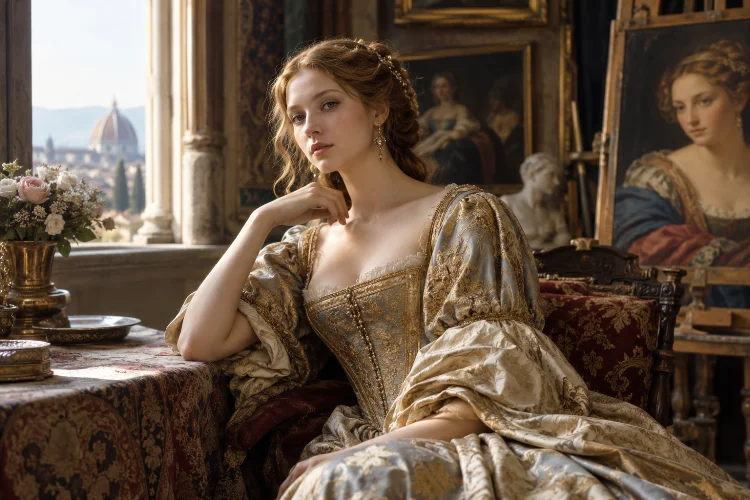
Imagine walking into a wealthy Italian household during the Renaissance and seeing paintings of women with luminous pale skin, high foreheads, golden hair, delicate features, and carefully controlled expressions.
These images were not simply decorations. They helped communicate what European society associated with beauty, virtue, wealth, and femininity.
Between roughly the 14th and 17th centuries, Renaissance art transformed how the female body and face appeared in European visual culture.
Artists revived classical Greek and Roman traditions while also responding to contemporary fashion, marriage customs, religion, and aristocratic expectations.
The relationship worked in both directions. Artists did not invent every beauty preference themselves; they painted ideals that already existed around them. However, widely admired portraits, mythological paintings, and religious images gave those preferences greater visibility.
Understanding how Renaissance art influenced European female beauty standards therefore means looking beyond famous masterpieces.
Paintings by Botticelli, Leonardo da Vinci, Titian, and other artists became part of a visual language that shaped ideas about the ideal European woman.
Renaissance Portraits Turned Beauty Into a Visible Social Ideal
Portraiture became increasingly important during the Renaissance, especially among wealthy families.
Commissioning a portrait allowed elite Europeans to preserve an individual’s appearance while also displaying family status, fashionable clothing, valuable jewelry, and social respectability.
Yet these portraits were not always straightforward records of what someone looked like. Artists could present sitters according to accepted ideas about attractiveness and dignity.
In 15th-century Italy, profile portraits were particularly fashionable for women. The Metropolitan Museum of Art notes that the format was commonly used for bridal portraits and was partly connected to renewed Renaissance interest in ancient Roman coins and medals.
A portrait could therefore do more than represent an individual woman. It could show viewers what a cultured, prosperous, and socially desirable woman was supposed to look like.
That gave art considerable cultural power. When similar traits appeared repeatedly in prestigious paintings, they became increasingly recognizable as signs of ideal femininity.
Pale Skin Became a Symbol of Refinement and Privilege
One of the most persistent characteristics in Renaissance female portraits is a very light complexion.
Pale skin had social meaning. For wealthy women, it could imply that they did not spend long hours performing agricultural or other outdoor labor. Fair skin consequently became associated with elite lifestyles, refinement, and social privilege.
Artists enhanced this impression by contrasting luminous faces with dark fabrics and backgrounds. Northern European paintings could produce particularly dramatic effects.
The National Gallery of Art’s description of a female donor painted by Petrus Christus around 1455, for example, highlights her pale white skin, blond hair, high forehead, and carefully arranged clothing.
Italian portraits followed comparable ideals. Leonardo da Vinci’s Ginevra de’ Benci presents smooth, light skin, subtle blush, and carefully controlled facial features.
The National Gallery of Art notes that blonde hair was highly prized in Renaissance Italy and connected with beauty, health, and virtue.
The fashionable complextion represented much more than skin color. It helped signal class.
Blonde Hair and High Foreheads Became Fashionable Features
Hair played an equally important part in Renaissance female beauty.
Literary and artistic traditions frequently celebrated golden or blonde hair. Women who did not naturally have this coloring could attempt to lighten their hair to approach the fashionable appearance shown in paintings.
Another striking preference was the high forehead.
According to the Metropolitan Museum of Art, the ideal woman described in Renaissance traditions could have blonde hair, pale skin, a long neck, and a high forehead. Some women reportedly plucked hair from their hairlines to exaggerate the height of the forehead.
Modern viewers sometimes assume unusual Renaissance hairlines were simply artistic conventions. In reality, fashion and art influenced one another.
Artists repeatedly represented fashionable women with exposed foreheads and carefully controlled hairstyles. Wealthy viewers saw similar characteristics in prestigious portraits, reinforcing their association with elegance.
The result was an early version of a familiar phenomenon: people adjusting their real appearance to resemble beautifull images circulating in popular culture.
Botticelli Connected Female Beauty With Classical Mythology
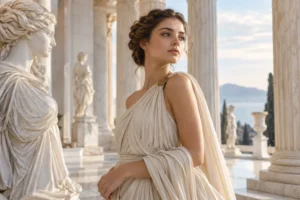
Renaissance fascination with the ancient world dramatically expanded the artistic possibilities for representing women.
Sandro Botticelli’s The Birth of Venus, painted around 1485, became one of the most famous examples. Venus appears with an elongated body, flowing golden hair, pale skin, and a graceful pose inspired partly by classical sculpture.
The Uffizi explains that Botticelli drew on ancient statues for Venus’s modest pose, while her long blonde hair contains golden highlights produced through the application of gold. The work presents Venus as a symbol of love and beauty.
Importantly, this is not a realistic portrait of an average Florentine woman. Venus is deliberately idealized.
Such mythological paintings helped create a space where female beauty could be explored more openly than in conventional religious portraiture.
Classical mythology gave artists an accepted cultural framework for showing the body, sensuality, flowing hair, graceful movement, and idealized physical form.
These images gradually became major reference points for European ideas about feminine beauty.
Titian Helped Popularize a Softer, More Sensual Female Ideal
Not every Renaissance beauty ideal emphasized extreme thinness. Venetian painting, particularly during the 16th century, often celebrated a softer and more physically substantial female body.
Titian’s Flora, painted around 1517, offers a revealing example. The young woman has luminous pale skin, pink cheeks, loose copper-blonde hair, and softly rounded features. The Uffizi describes these characteristics as fitting the aesthetic ideals of 16th-century Renaissance beauty.
Titian’s Venus of Urbino went even further in presenting the female nude as warm, sensual, and physically present. Painted in 1538, the work shows a reclining woman in an elite Venetian domestic interior.
The Metropolitan Museum notes that Venetian artists revived the classically inspired female nude but often emphasized the seductive warmth of the body rather than simply copying mathematical proportions from ancient sculpture.
This contributed to a Renaissance ideal in which soft flesh, rounded hips, and visible physical abundance could signal health, fertility, luxury, and sensual attraction.
Clothing and Jewelry Made Beauty a Sign of Wealth
Female beauty in Renaissance art was never limited to facial structure or body shape.
Clothing could be just as important.
Elite portraits displayed expensive fabrics, elaborate sleeves, pearls, fur, embroidery, necklaces, and carefully arranged hair. These items communicated that the sitter belonged to a privileged social world.
Titian’s Portrait of a Lady, commonly known as La Bella, is a perfect example. The woman wears an expensive blue damask dress with gold embroidery, velvet elements, and fur.
According to the Uffizi, her high forehead, pale cheeks, lively gaze, and honey-colored hair also correspond with Italian Renaissance aesthetic ideals.
Beauty was therefore partly something that money could construct.
A wealthy woman’s appearance depended on access to fashionable fabrics, professional tailoring, cosmetics, servants, jewelry, and time for careful grooming.
Renaissance paintings made that aristocractic version of femininity highly visible, even though most European women could never realistically reproduce it.
Artists Balanced Female Beauty With Virtue and Modesty
A Renaissance woman was not simply expected to appear attractive. In many social settings, ideal beauty was supposed to suggest moral character as well.
This created an interesting tension for painters.
A woman could be beautiful, but excessive sensuality might conflict with expectations surrounding modesty, marriage, and religious virtue. Portraits therefore often feature controlled expressions, carefully positioned hands, expensive but respectable clothing, and calm poses.
Physical appearance could even be interpreted as evidence of inner qualities. Renaissance discussions sometimes linked outward beauty with goodness, virtue, or nobility.
Artists learned to communicate these ideas visually.
A composed face might suggest discipline. Pale skin suggested refinement. Fine clothing represented family status. Jewelry demonstrated wealth, while posture and restrained expression could reinforce respectability.
This combination of appearance and morality made female beauty an unusually complicated social ideal.
Renaissance Art Did Not Create One Universal Beauty Standard
It is tempting to talk about “the Renaissance beauty standard” as though every European woman was expected to look identical.
Reality was far more complicated.
The Renaissance lasted centuries and stretched across regions with different cultural traditions. Beauty in Florence was not necessarily presented exactly like beauty in Venice, Flanders, France, or England.
Northern Renaissance portraits often emphasized extraordinarily precise textures, clothing, veils, and individual facial detail. Italian artists increasingly experimented with classical mythology, idealized bodies, and later the female nude.
Even within Italy, fashions changed.
What remained important was the growing influence of visual culture. Paintings presented repeated combinations of pale skin, carefully shaped hair, youthful faces, fashionable clothing, high foreheads, soft bodies, and graceful poses.
These patterns created a recognizable vocabulary of female attractiveness, even when there was never a single rigid formula.
Renaissance Art Created an Early Form of Beauty Media
One reason Renaissance art mattered so much is that prestigious images traveled.
Paintings could move between royal and aristocratic collections. Engravings allowed compositions to circulate even more widely, while influential artistic styles were copied by other painters and workshops.
Titian’s Flora, for instance, became sufficiently celebrated that numerous engravings were produced from it beginning in the 16th century.
This made Renaissance art something more than passive documentation.
Images could repeat and strengthen particular appearances. Viewers encountered the same visual language across portraits, mythological scenes, courtly collections, and religious works.
There was no Instagram algorithm pushing fashionable faces across Europe, of course. But art still provided an influential system for circulating idealized appearances.
In that sense, Renaissance painting functioned as an early form of beauty media.
Renaissance art influenced European female beauty standards by turning cultural preferences into powerful visual ideals.
Pale skin, blonde or golden hair, high foreheads, youthful features, luxurious clothing, graceful posture, and softly rounded bodies repeatedly appeared in some of Europe’s most admired artworks.
Yet Renaissance artists did more than dictate fashion. Their paintings both reflected existing preferences and helped reinforce them, creating an ongoing exchange between everyday appearance and artistic representation.
Works by Botticelli, Leonardo, Titian, and Northern European painters show that beauty was closely connected to class, morality, marriage, classical culture, and wealth.
Look closely at Renaissance portraits the next time you visit a museum or digital collection. Behind every carefully painted face is a larger story about how European society decided what beauty was supposed to mean.